

Ganesha Fortune Free-to-Play Review for EN 365
Ganesha Fortune is presented here as a fictional free-to-play game concept designed for entertainment, visual engagement, and casual session exploration without real-money stakes. The page should not be understood as a gambling offer, a deposit-based product, or a promotional invitation. Instead, this review looks at Ganesha Fortune as a browser-based themed game experience where the main value comes from design quality, interface clarity, symbolic structure, and how comfortably the game could fit into a responsible entertainment environment.
The first thing I would assess in a free-to-play title like Ganesha Fortune is not payout potential, because there is none in this concept. The more relevant question is whether the game feels polished, readable, and balanced enough for users who want a short visual experience without financial pressure. A good free-to-play game should make its limits obvious. There should be no confusing payment prompts, no misleading reward language, and no mechanics that blur the line between casual entertainment and real-money gambling.
From that perspective, Ganesha Fortune works best when positioned as a mythology-inspired digital game with a calm structure and a controlled interface. The theme can draw from Indian visual motifs, festive colours, ornate patterns, and symbolic fortune imagery, but it should avoid treating cultural or religious references carelessly. The concept needs to feel respectful rather than decorative for the sake of attention. A refined presentation would use gold, deep blue, warm red, and soft light effects to create atmosphere without turning the screen into an overloaded visual field.
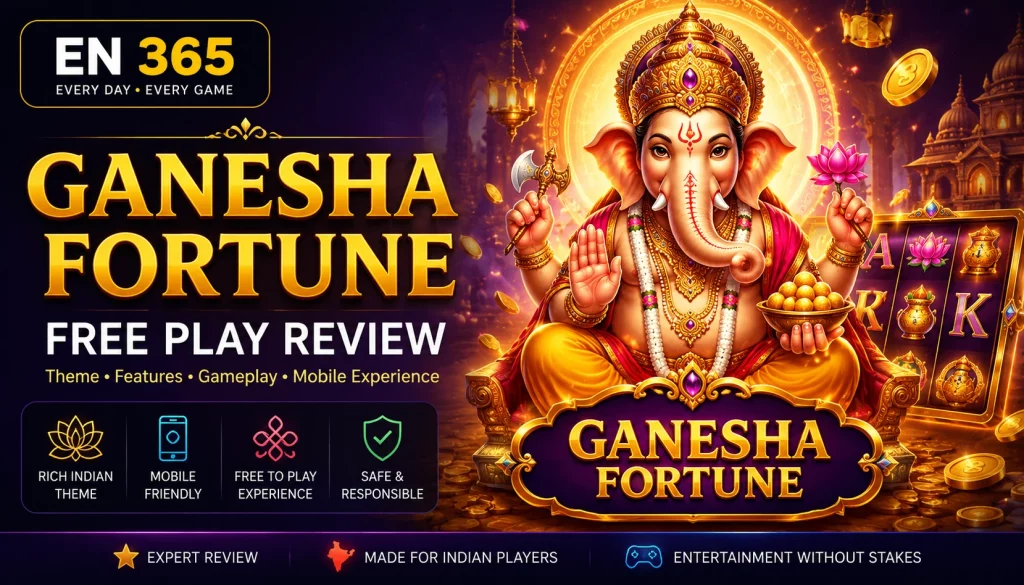
Visual Identity and Theme Structure
The visual identity of Ganesha Fortune should be built around clarity first. Many themed games fail because the symbols look attractive individually but become difficult to read during motion. In a free-to-play environment, this matters because the user is not evaluating financial outcomes; they are evaluating whether the experience is pleasant, legible, and worth returning to as casual entertainment.
A strong version of Ganesha Fortune would use a layered background, gentle animations, and a symbol set that remains readable on mobile screens. The main visual space could include lotus patterns, temple-inspired arches, ornamental frames, bells, coins as decorative icons, and soft glowing effects. These details should support the atmosphere rather than compete with the main grid.
The theme should also avoid excessive sound pressure. Short musical loops, soft chimes, and optional sound controls would make the experience more accessible. A player should be able to mute the game immediately, adjust volume, or continue silently without losing interface feedback. This is especially important for users browsing from mobile devices in public or shared spaces.
In my view, the strongest version of Ganesha Fortune would not rely on constant flashing animations. It would feel more premium if the motion stayed measured: soft symbol transitions, clear result states, and short visual celebrations that end quickly. Free-to-play design does not need artificial urgency. It works better when the platform allows the user to understand what is happening without pressure.
Interface Flow and Access Experience
The interface should make the free-to-play nature obvious before the user enters the game screen. If EN 365 presents this page as an informational review, the surrounding structure should clearly explain that no deposit, wager, withdrawal, or prize claim is involved in this version. That protects user expectations and makes the page feel more credible.
A clean Login area may exist for account access on the wider website, but Ganesha Fortune as a fictional free-to-play title should not require financial verification or payment setup. If account access is used, it should be limited to saving preferences, display settings, or session history. The game should not push users toward deposits, paid upgrades, or time-limited offers.
The same applies to Sign up language. If registration is mentioned anywhere on the page, it should be framed as optional account access for non-financial features, not as a gateway to paid gameplay. This distinction is important because free-to-play content becomes less trustworthy when the interface looks casual but the surrounding page creates commercial pressure.
A browser-first version would also reduce friction. Users should not need a heavy download to understand the core interface. If an App reference appears elsewhere on EN 365, the Ganesha Fortune review should still make clear that the reviewed concept is about visual entertainment and not about real-money access. A lightweight mobile experience is more valuable here than aggressive install prompts.
Game Mechanics Without Wagering
Ganesha Fortune, as reviewed here, should use symbolic mechanics only. That means spins, rows, symbol combinations, or reward animations can exist as part of the entertainment loop, but they should not represent money, cash prizes, or redeemable value. The safest and clearest approach is to describe outcomes as visual events, score markers, or progress animations.
The core loop could be simple: the user starts a round, symbols animate, and the screen displays a result pattern. This pattern may unlock visual effects, decorative badges, or non-monetary progress indicators. The important point is that none of these results should create the impression of financial gain. The purpose is entertainment, not betting.
This makes Ganesha Fortune different from conventional Slots pages. A real-money slot review often focuses on RTP, volatility, wagering rules, payment access, and bonus conditions. This free-to-play version should avoid those conversion-focused details. Instead, the review can focus on pacing, readability, animation smoothness, mobile comfort, and whether the design communicates its limits honestly.
The same distinction applies to Games categorisation. Ganesha Fortune can belong to a casual visual game section, but it should not be described as a route to winnings. For an expert-style page, this difference is not a small disclaimer. It should shape the full article.
Mobile Behaviour and Screen Readability
Mobile performance is central to a game like Ganesha Fortune because many users in India browse entertainment content from smartphones. A free-to-play game does not need a complex interface. It needs stability, fast loading, and controls that remain usable without zooming or rotating the screen unnecessarily.
The best mobile layout would keep the symbol area central and place secondary controls below it. Text should be minimal during active rounds, while explanatory content can remain on the surrounding review page. This keeps the game screen clean and prevents the user from feeling overwhelmed by instructions.
Button spacing also matters. Free-to-play games often use bright buttons to create energy, but oversized or repeated action buttons can feel manipulative. Ganesha Fortune would benefit from one main action button, one settings button, and a clear information panel. A simple structure creates more trust than a crowded control bar.
Loading behaviour should also be predictable. If the page includes animation assets, they should be compressed for mobile use. A visually rich game that loads slowly will feel weaker than a simpler game that starts smoothly. The strongest experience is not the heaviest one; it is the one that feels stable across average devices and mobile networks.
Popular Free-to-Play Style Slots for Indian Users
For an India-oriented entertainment page, it can be useful to mention popular slot-style themes that users often recognise in casual or demo-style environments. This should be handled carefully and without suggesting real-money play. The list below is framed only as thematic comparison for free-to-play or demo-style browsing:
- Book of Dead-style adventure themes with explorer visuals and simple symbol recognition
- Gates of Olympus-style mythological layouts with high-impact animation sequences
- Sweet Bonanza-style colourful grid formats with bright candy-inspired visuals
- Dragon Tiger-style Asian table-game inspired visuals adapted into casual formats
- Teen Patti-inspired card visuals used in non-wagering entertainment interfaces
- Fruit-themed classic slot layouts with simple symbols and quick visual feedback
- Festival-themed games using lights, gold accents, and celebratory background effects
Ganesha Fortune would sit most naturally among visually rich, mythology-inspired free-to-play titles. Its advantage would not come from complexity, but from how well it combines atmosphere, readability, and responsible presentation. If the design remains transparent about its fictional and non-financial nature, it can feel more credible than pages that use free content as a disguised conversion path.
Trust Signals and Page Clarity
A credible EN 365 page should include visible trust signals around Ganesha Fortune. These do not need to be heavy legal blocks, but the reader should understand the boundaries immediately. The page should say that the concept is free-to-play, fictional, and not connected to deposits or prize claims. It should also avoid using reward-heavy language that might confuse casual readers.
The surrounding page structure can include a calm explanation area, a visual review table, a responsible entertainment note, and later a clear FAQ section. If Links are included, they should point only to informational or responsible-play resources, not to payment pages or conversion-focused destinations.
For India-focused context, any external references should be handled responsibly. If an article later includes authority resources, those links should support user awareness, digital safety, or responsible entertainment standards. They should not be presented as proof that real-money play is recommended.
Overall, the strongest first impression for Ganesha Fortune is a controlled one. The concept can be colourful and engaging, but it should not pressure the reader. It should feel like a polished entertainment review with clear boundaries, respectful theming, and transparent free-to-play framing.
Session Rhythm and User Comfort
Ganesha Fortune becomes more interesting when I look beyond its first visual impression and focus on how the session actually feels over time. In a free-to-play environment, this is one of the most important quality markers. A game can look attractive in screenshots, yet still feel tiring after only a few minutes if the pacing is too aggressive or if the interface constantly asks the user to react. For this concept to work well, the rhythm has to remain calm, readable, and intentionally limited.
What I would expect from a polished version of Ganesha Fortune is a controlled pace that gives each round a clear beginning, middle, and end. The player should be able to understand what happened without visual chaos. That sounds simple, but it is where many themed entertainment products lose their balance. If every moment is treated as a major event, nothing feels special. A more refined game allows small visual rewards to breathe instead of flooding the screen with motion after every interaction.
This is especially relevant on mobile. A free-to-play title should not demand constant precision or fast reactions unless that is the core concept. Ganesha Fortune feels better suited to a low-pressure style where the user taps, watches a brief result sequence, and moves forward without confusion. That makes it easier to return to the game casually during short breaks. It also creates a more respectful relationship with the player because the interface does not try to dominate attention.
A good session rhythm also reduces fatigue. Colour, motion, and sound should support the experience rather than create stress. If Ganesha Fortune uses festive visual language, then it should do so with restraint. Gold highlights, temple-inspired framing, and glowing accents can create atmosphere, but they should never undermine readability. The best free-to-play experiences are often the ones that feel most stable.
The chart above reflects how I would evaluate Ganesha Fortune as a fictional free-to-play product rather than as a gambling title. The strongest qualities should come from clarity, comfort, and a low-pressure interface. Those are much more meaningful than any artificial excitement because they determine whether the game feels pleasant across repeated sessions.
Cultural Tone and Presentation Quality
A mythology-inspired game theme can quickly become superficial if it relies only on decorative clichés. That is why Ganesha Fortune needs a stronger design logic. The visual references should feel intentional, with symbols and environments used to support atmosphere rather than just fill the screen with ornate detail. The game concept becomes more credible when every element seems to belong to the same visual language.
In practical terms, this means the background, symbol frames, animation style, and sound effects should all align. If the background uses festive architecture and warm ceremonial colours, then the icon system should echo that design rather than switch into unrelated neon effects. Consistency is what creates quality. I would rather see fewer visual elements handled well than many disconnected features competing for attention.
The strongest thematic choice is moderation. Ganesha Fortune does not need to imitate the overload often seen in commercial entertainment pages. It can stand out by being more composed. A carefully designed free-to-play review page for EN 365 should communicate that this title is interesting because of presentation and atmosphere, not because it tries to simulate financial importance.
This also makes the game concept easier to explain. Readers who arrive on the page should understand that the focus is on visual enjoyment, interface comfort, and casual exploration. That is a clearer editorial angle than trying to make a non-wagering product feel like a high-stakes experience.
Accessibility and Responsible Entertainment Design
Accessibility is another area where Ganesha Fortune can become stronger than a typical casual game page. Accessibility does not only mean technical adjustments. It also means reducing friction, limiting confusion, and giving the player control over how the game is experienced. Volume controls, readable fonts, visible buttons, and a clean contrast structure can make the product more inclusive without making it less attractive.
A well-designed free-to-play experience should also reduce psychological pressure. This is where interface ethics matter. No fake urgency, no countdown pressure, no misleading “claim” language, and no visual tricks that make a user feel they are missing out on something valuable. Even in a fictional game concept, that distinction matters because it defines how trustworthy the page feels.
I also think replay sessions should remain short by design. Casual entertainment works best when it fits naturally into real life rather than trying to prolong itself through artificial tension. Ganesha Fortune would benefit from brief, self-contained interactions that feel complete after a few minutes. A title that respects the user’s time often leaves a better impression than one that tries too hard to keep the session going.
For EN 365, this creates a more expert and editorial tone. The review becomes less about spectacle and more about whether the product concept is responsibly constructed. That approach feels more credible and much more useful for readers who want clear evaluation rather than empty praise.
Overall Mid-Article Assessment
At this stage, Ganesha Fortune works best as a free-to-play concept built around comfort, visual harmony, and light engagement. Its strengths do not come from complexity. They come from restraint. The game is more convincing when it presents itself as a polished digital pastime with respectful theming and controlled pacing.
What stands out most is the opportunity for balance. The concept has enough visual identity to feel memorable, but it should avoid the pressure patterns often associated with cash-oriented gaming products. If the final execution keeps the session readable, the mobile interface smooth, and the thematic style cohesive, then Ganesha Fortune can feel like a genuinely well-shaped entertainment page rather than a disguised promotional funnel.
That is the standard I would apply to the title. A good free-to-play review should help the reader understand not only what the game looks like, but also how it behaves. In that respect, Ganesha Fortune has the right foundation when it prioritises comfort, transparency, and calm design over noise.
Content Depth and Editorial Usefulness
Ganesha Fortune becomes more credible when the page explains the experience instead of only describing the visuals. A free-to-play review should not rely on surface-level phrases such as “exciting,” “colourful,” or “rewarding” without explaining what those qualities actually mean in practice. For EN 365, the stronger editorial approach is to examine how the concept behaves: how readable the screen is, how predictable the controls are, how quickly a user understands the limits, and whether the design avoids creating pressure.
A useful review should also separate theme quality from interaction quality. A game may have an attractive visual identity, but if the buttons feel unclear or the animation timing is inconsistent, the session becomes weaker. Ganesha Fortune should be judged across several layers at once: first impression, mobile usability, visual rhythm, accessibility, and transparency. This gives the article more substance and makes it feel like a real evaluation rather than generic promotional content.
The page should also explain what the game does not do. Because this version is framed as fictional and free-to-play, it should not create expectations around financial outcomes, prize claims, deposit routes, or withdrawal mechanics. That boundary is not a limitation; it is part of the product identity. A clear non-cash concept can feel more trustworthy because the user understands the purpose before interacting with it.
From an editorial perspective, Ganesha Fortune should be treated as a visual entertainment product. The review should help readers decide whether the concept is comfortable, transparent, and well-designed. It should not push urgency or suggest that the user needs to act immediately. The most convincing page is the one that feels calm, specific, and honest about what the experience offers.
Design Restraint and Long-Term Trust
A strong free-to-play page depends on restraint. If Ganesha Fortune uses too many animated effects, the experience may look impressive for a few seconds but lose credibility quickly. The more useful design direction is selective intensity. Important moments can receive visual emphasis, while ordinary transitions should stay clean and quiet. This helps the game feel premium instead of noisy.
Trust also comes from predictable language. The page should not describe visual results as if they carry financial meaning. Terms that suggest claims, cash value, or guaranteed outcomes should be avoided entirely in this version. Instead, the review can use language such as visual result, session marker, animation sequence, progress state, or decorative milestone. These phrases keep the entertainment value clear without creating false expectations.
Another important detail is how the interface handles repetition. Free-to-play content often becomes weak when it relies on the same loop without variation. Ganesha Fortune can solve this through small atmospheric changes rather than pressure-based mechanics. Background lighting, symbol transitions, short sound cues, and gentle progress indicators can create variety without making the experience feel manipulative.
A real expert review should notice these differences. It should not only say that the game is smooth; it should explain why smoothness matters. It should not only say that the design is attractive; it should explain whether the design remains readable when the screen is active. That level of detail is what separates a credible EN 365 page from a thin content template.
Symbol Logic and Visual Hierarchy
The symbol system is one of the most important parts of Ganesha Fortune. In a themed visual game, symbols are not just decoration. They guide the user’s attention, create rhythm, and help the screen communicate results. If the symbols are too similar in shape or colour, the game becomes harder to read. If they are too different, the visual identity can feel fragmented.
A balanced symbol set would use clear contrast between primary and secondary icons. Main symbols should have stronger outlines, brighter highlights, and more recognisable silhouettes. Secondary symbols can remain softer and less dominant. This hierarchy helps users understand the screen quickly, especially on smaller mobile displays.
The background should also remain subordinate to the active play area. Ornamental patterns can look refined, but they should not compete with the grid. The best approach is to use detail at the edges of the screen and keep the central area cleaner. This gives the theme enough richness while preserving functional readability.
For Ganesha Fortune, the ideal visual hierarchy would feel ceremonial but not crowded. The user should notice the atmosphere immediately, then understand the controls without searching. That sequence matters. First the page creates mood, then it communicates function. If those two layers are reversed or mixed too aggressively, the experience becomes less polished.
Mobile-First Editorial Testing
A page like this should be evaluated from mobile first, not desktop first. Many users will not experience the layout on a large screen. They will see the review, table, and game concept from a smartphone browser, often with limited attention and variable connection quality. That means the article design and embedded components need to remain light, responsive, and easy to scan.
The vertical flow table is useful because it mirrors how mobile users naturally read content. Instead of forcing wide columns into a narrow screen, each card presents one editorial point at a time. This structure feels more premium because it respects the user’s device. It also prevents important details from being compressed into unreadable rows.
Mobile-first testing should include text size, button spacing, loading behaviour, and contrast. If the table looks strong on desktop but becomes cramped on a phone, it does not serve the page properly. A responsible entertainment review should feel stable in practical conditions, not only in a preview window.
The same principle applies to the surrounding paragraphs. Long blocks should be readable but not empty. Each paragraph needs a distinct purpose: interface behaviour, visual clarity, symbol design, accessibility, or trust. This keeps the article from repeating itself and gives the page a more professional rhythm.
Responsible Entertainment Positioning
Ganesha Fortune should be positioned as casual entertainment with explicit limits. That framing makes the review cleaner and more defensible. The page does not need to imitate a commercial slot review, and it should not borrow the pressure language commonly used in conversion-focused casino content. Its value comes from transparency.
Responsible positioning can be handled naturally inside the article. It does not need to feel like a legal warning pasted onto the end. The review can mention that the concept avoids deposits, withdrawals, redeemable value, and real-money claims. It can also explain that good free-to-play design should give users control over sound, time, and session flow.
The strongest editorial tone is firm but not dramatic. The page should not overstate risks, but it should clearly avoid encouraging risky behaviour. For an India-oriented audience, this is especially important because readers may encounter mixed messages across entertainment, gaming, and real-money products online. A clean free-to-play article should remove that ambiguity.
In this form, Ganesha Fortune becomes easier to trust. It is not presented as a shortcut to winnings or as a hidden commercial route. It is reviewed as a fictional visual experience with defined boundaries. That makes the page more useful, more transparent, and more aligned with a professional content standard.
Editorial Verdict on Structure and Usability
Ganesha Fortune has the strongest foundation when its structure remains simple and its presentation stays controlled. The theme gives the concept personality, but usability determines whether the experience feels credible. A clear screen, readable symbols, responsive controls, and transparent non-cash framing are more valuable than heavy animation or exaggerated excitement.
The review should continue to treat the game as a designed experience rather than a promotional object. That means every section needs to answer a practical question: Is the page clear? Is the mobile layout comfortable? Does the theme feel respectful? Does the interface avoid pressure? Does the user understand that the concept has no financial outcome?
When those questions are answered directly, the page becomes stronger. It reads like an expert evaluation instead of a generic description. For EN 365, that is the right direction. Ganesha Fortune should feel visually rich, but editorially disciplined. It should show atmosphere without confusion, engagement without pressure, and entertainment without misleading expectations.
Evaluation of Ganesha Fortune as a Free-to-Play Concept
Ganesha Fortune works best when its identity remains clearly separated from real-money gaming. The strongest version of this concept is not built around financial expectation, prize language, or aggressive conversion elements. It is built around visual comfort, respectful theme design, smooth interaction, and transparent free-to-play limits. That distinction gives the page a more professional tone and makes the review more useful for readers who want to understand the experience without being pushed toward risk.
The final evaluation should focus on how the concept behaves as a complete entertainment product. A free-to-play game can still be reviewed seriously, but the review criteria need to be different. Instead of discussing payment speed, wagering value, or cashout conditions, the article should examine usability, visual rhythm, accessibility, device stability, session control, and clarity of communication. These are the factors that define whether Ganesha Fortune feels polished or superficial.
The most important strength of the concept is its potential for visual identity. A mythology-inspired structure can create a memorable atmosphere when handled with care. Warm gold, deep blue, soft red, decorative borders, temple-like framing, and symbolic iconography can make the game visually distinctive. However, the design should never rely only on decoration. Every visual layer should support readability. If the screen becomes crowded, the theme loses its impact.
The second major strength is the possibility of calm session pacing. Ganesha Fortune does not need fast pressure cycles or artificial urgency. A fictional free-to-play version should feel controlled, with short rounds, clear result states, and smooth transitions. The user should always understand what is happening and should never feel manipulated by countdowns, forced prompts, or exaggerated visual signals.
The chart gives a practical overview of how Ganesha Fortune should be evaluated as a fictional free-to-play experience. Visual design is important, but it should not dominate the entire product. Transparency and mobile comfort carry almost equal weight because they determine whether the reader understands the concept and whether the experience feels usable in real conditions. Responsible structure remains essential because the page should never blur free entertainment with financial expectation.
Practical Usability Verdict
From a usability perspective, Ganesha Fortune should be judged by how little explanation it needs once the user reaches the game area. A polished interface does not force the user to decode basic controls. It presents the main action clearly, keeps secondary settings available but unobtrusive, and allows the user to leave or pause without friction. This matters because free-to-play entertainment should feel voluntary at every step.
The mobile version remains the most important test case. A desktop preview may make the visual theme look impressive, but the real quality appears on a smaller screen. Text must stay readable, buttons must remain easy to tap, and animations should not create visual noise. A game with a rich theme can still feel light if the interface is well controlled.
Ganesha Fortune should also avoid unnecessary account barriers. If the wider EN 365 environment includes account features, the review should still make clear that this concept does not require payment access or financial verification. Optional account tools may support saved preferences or display settings, but they should not become a pressure point. The user should understand that the game concept is accessible as entertainment, not as a financial product.
The same logic applies to notifications and reminders. A free-to-play concept should not rely on persistent prompts to bring the user back. A stronger product earns return visits through comfort and design quality. If the game needs constant reminders to feel relevant, then the underlying experience is probably not strong enough.
Responsible Language and Reader Trust
The language around Ganesha Fortune should stay precise. Words such as prize, winnings, claim, cash, deposit, and withdrawal should not shape the page because they do not fit the fictional free-to-play framing. The better vocabulary is built around visual rounds, symbolic outcomes, animation states, interface flow, comfort, design clarity, and entertainment rhythm.
This type of language gives the review a more credible editorial voice. It tells readers exactly what they are evaluating. They are not being asked to consider financial upside. They are being shown how a themed game concept performs as a visual and interactive experience. That makes the content cleaner and more useful.
Trust also depends on what the page refuses to exaggerate. Ganesha Fortune should not be described as life-changing, highly rewarding, or essential. Those words feel artificial and weaken the review. A more realistic assessment is stronger: the concept may be visually appealing, comfortable on mobile, and suitable for short casual sessions, provided the design remains transparent and non-pressuring.
For an India-focused audience, this clarity is especially important. Online entertainment pages can become confusing when casual gaming language and gambling-style language overlap. A responsible article removes that confusion by defining the concept plainly and keeping the page consistent.
Final Recommendation for Page Positioning
Ganesha Fortune should be positioned as a fictional free-to-play visual game review with a premium entertainment angle. The page can highlight design quality, smooth interaction, mobile readability, and theme atmosphere, but it should not imitate a real-money slot review. That editorial separation is the main reason the article feels professional.
The strongest page structure is one that keeps the reader informed from start to finish. The opening should define the non-cash format. The middle sections should evaluate theme, usability, rhythm, and accessibility. The final sections should reinforce responsible entertainment design and explain why transparency improves the product. This gives the article a complete expert structure without relying on empty promotional claims.
Ganesha Fortune has enough conceptual depth to support a full review because it can be analysed through design behaviour rather than financial mechanics. Its success depends on restraint: fewer pressure signals, cleaner controls, more readable symbols, and a stronger commitment to honest framing. When handled this way, the concept can feel polished, culturally styled, and suitable for casual browser-based entertainment.
The final verdict is positive but conditional. Ganesha Fortune works as a free-to-play idea when the page keeps its limits visible and treats the game as entertainment only. Its best qualities are visual atmosphere, mobile comfort, and calm pacing. Its main risk is any attempt to make the concept sound like a financial opportunity. As long as that line stays clear, the review can read like a real expert assessment rather than generic casino content.
Ganesha Fortune FAQ
This FAQ explains Ganesha Fortune as a fictional free-to-play entertainment concept for EN 365, focusing on design, usability, mobile comfort, and transparent non-cash gameplay.






Comments