
Documents Required India Casino Verification
Documents Required for India Casino Verification
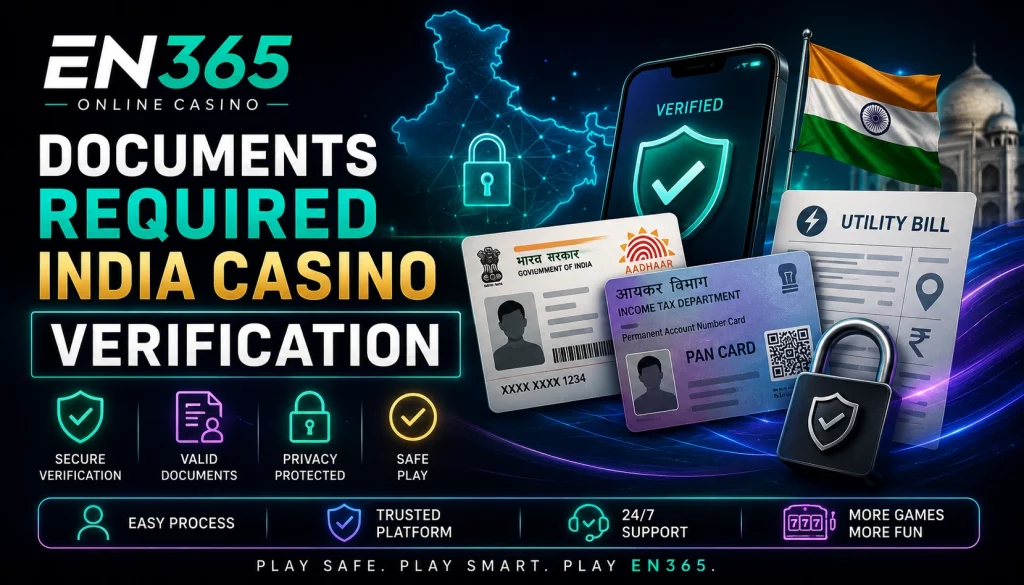
Documents required for India casino verification should be understood as a privacy and identity-safety topic before anything else. When a platform asks a user to confirm identity, address, payment ownership, or account consistency, the request may appear routine on the surface. In practice, it can involve sensitive records such as PAN details, Aadhaar-linked information, bank statements, utility bills, payment screenshots, or identity images. These documents can expose more than a name. They may reveal financial links, residential history, transaction patterns, mobile connections, or government identity references.
For EN 365 readers in India, the safest approach is to treat document verification as a decision point. A polished interface, quick Login process, or professional-looking account area does not automatically prove that a platform handles personal files responsibly. Before sharing any document, users should ask why the file is needed, how much information it reveals, who reviews it, how long it may be stored, and whether the platform explains its privacy process clearly.
This guide is written as an awareness resource, not as a shortcut to pass verification. The purpose is to help Indian users understand document categories, privacy exposure, verification pressure, and safer review habits before sensitive information is shared online. A real expert page should not simply list documents. It should explain the risk behind each document type and help readers judge whether the request is reasonable.
Why Verification Documents Need Careful Review
Verification documents are not equal in sensitivity. A basic name check carries one level of risk, while an address document, bank statement, or government identity record carries a much higher level of exposure. A user may upload a file to confirm one detail, but the document may show many other details that are not relevant to the review.
A PAN card may connect tax identity with a legal name. An Aadhaar-related document may connect identity, address, and broader personal records. A bank statement may confirm payment ownership but may also reveal balances, transaction history, account numbers, branch details, and third-party names. A utility bill may confirm address but may also show customer numbers, billing cycles, exact residence, and service-provider data.
This is why proportionality matters. A responsible platform should not ask for more information than it can clearly justify. If the purpose is age confirmation, the document request should be limited to that purpose. If the purpose is payment ownership, the platform should not automatically demand unrelated address or identity files without explaining why. If the purpose is account safety, the user should receive a clear reason rather than a vague demand for “documents.”
Common Document Categories in India
The most common verification categories are identity proof, address proof, payment proof, and sometimes selfie or live-photo checks. Each category has a different purpose. Identity proof may confirm that the user is a real person and that account details match legal records. Address proof may confirm residence or location consistency. Payment proof may confirm that the payment method belongs to the same account holder. A selfie check may be used to reduce impersonation risk.
The problem begins when a platform does not explain which category is required and why. A vague request for “documents” is too broad. Users should know whether the review is connected to identity, address, payment, security, account activity, or risk control. Without this clarity, users may share more information than necessary.
Indian users should also be careful with files that contain combined information. For example, a bank statement can act as both payment proof and address proof, but it also exposes financial behaviour. An Aadhaar-linked document may confirm identity and address, but it may also create broader privacy exposure. A utility bill may be less financially sensitive, but it still shows residential details and account references.
What Makes a Document Request Reasonable
A reasonable document request is specific, limited, and explained in plain language. It should identify the document type, the reason for the request, the required visibility of details, the accepted file format, and the expected review process. It should also explain whether unrelated information can be hidden before upload.
A weak request feels different. It may ask for multiple documents at once without stating why. It may pressure users to upload files quickly. It may connect document sharing to promotional claims, unclear account restrictions, or vague “security” wording. It may also provide no support path for users who want to ask privacy questions before submitting files.
For EN 365 readers, this distinction is important. The safest verification decision is made before upload, not after a document has already been shared. Users should not treat document requests as routine simply because the website looks modern or because account navigation feels smooth. Verification documents deserve a separate privacy review.
Document Priority and Privacy Exposure
The documents required for India casino verification should not be treated as one equal group. Some documents reveal only a limited piece of information, while others expose identity, residence, financial history, and payment behaviour at the same time. This is why users should think in terms of priority and exposure before sharing files online.
A responsible platform should request the least sensitive document that can reasonably support the verification purpose. If the account review concerns address, a utility bill may be less revealing than a full bank statement. If the review concerns payment ownership, the platform should explain exactly which payment detail is needed and whether unrelated balances or transactions can be hidden. If the review concerns identity, the platform should not ask for several identity files without a clear reason.
Users should be especially cautious when document collection appears next to a Bonus page or promotional flow. Verification should not feel like a rushed step attached to a reward. A privacy decision should be based on clarity, proportionality, and user control, not on urgency or marketing pressure.
How to Read the Document Exposure Chart
The chart is not a legal rating and not a platform endorsement. It shows a practical privacy pattern. A bank statement usually carries the highest exposure because it can reveal address, payment ownership, account numbers, balances, transaction history, branch data, and third-party references. An Aadhaar-linked record may also carry high exposure because it can connect identity and residence in a way that is difficult to separate.
A PAN card is sensitive because it relates to tax identity and legal records. A utility bill may be less financially revealing, but it still shows residence, service-provider details, billing information, and customer references. A payment screenshot may look simple, but it can expose transaction IDs, UPI handles, phone numbers, timestamps, bank names, or wallet identifiers.
The most important lesson is that document choice should be deliberate. Users should not upload the first file they find on their phone. They should understand what each document reveals and whether the platform explains what information must remain visible. If the platform does not provide this clarity, the request should be treated as incomplete.
Why Document Stacking Can Be a Warning Sign
Document stacking happens when a platform asks for several categories of proof at the same time. For example, it may request identity proof, proof of address, bank evidence, payment screenshots, and a selfie check together. In some regulated contexts, layered checks may have a legitimate purpose, but the platform should clearly explain why each layer is needed.
The risk is that users may submit too much information simply because they want the review finished quickly. This is especially common when the verification screen uses vague language or gives the impression that more documents will speed up approval. In reality, sending extra files can create more exposure and does not necessarily improve the quality of the review.
A stronger platform should keep document requests organised. It should ask for a specific file, explain the reason, and avoid unnecessary repetition. If additional proof is needed, the reason should be stated clearly. Without that explanation, document stacking becomes a privacy concern.
Promotional Pressure and Verification Decisions
Verification should remain separate from promotional language. If a document request appears immediately after a reward claim, prize message, or promotional offer, users should slow down and separate the two decisions. A reward is temporary, but identity exposure can be long-term.
A platform that uses promotional pressure during verification may encourage users to act before they fully read the terms. That is not a strong safety signal. A better process explains document requirements calmly and gives users enough time to review privacy conditions. It does not imply that sensitive files should be uploaded quickly to avoid missing out.
For Indian users, the safest standard is simple: identity, address, and payment documents should only be shared when the purpose is clear, the request is proportionate, and privacy terms are readable before upload. A verification page should never make the user feel that caution is an obstacle.
Document Timing, Account Review and Verification Sequence
Verification documents are usually reviewed in a sequence, even when the platform does not describe that sequence clearly. A user may first submit basic account information, then identity proof, then address proof, then payment evidence, and sometimes an additional selfie or manual support request. When this order is not explained, the process can feel unpredictable, and users may start uploading more files than necessary.
For Indian users, the safer standard is transparency before submission. A platform should explain what it needs first, what may be requested later, and which situations can trigger extra checks. If the user only learns about each document after the previous upload, the process becomes harder to judge. Step-by-step verification is not automatically unsafe, but hidden escalation is a privacy problem.
This is especially relevant after Sign up, because a fast registration flow may not reveal how detailed the later document review can become. A user may create an account quickly, then discover that identity, address, and payment records are required before certain account actions are reviewed. A responsible platform should not let users reach that point without clear expectations.
Why Verification Escalation Should Be Explained
Verification escalation is not automatically a sign of misuse. A platform may need more information when records do not match, when account activity changes, or when a payment method requires ownership confirmation. The problem begins when users are not told why the request escalated. Without a reason, they may submit extra files blindly.
A clear process should explain the trigger. Did the account name differ from the payment record? Was the address incomplete? Was the document unreadable? Was there a country or location mismatch? Was a previous file outdated? These are very different issues, and each should require a proportionate response. A generic instruction to “upload more documents” is not enough.
Indian users should be careful with repeated upload cycles. If a platform rejects one file and requests another without explaining the specific issue, the user may keep submitting increasingly sensitive records. That pattern creates privacy exposure and should be treated as a warning sign.
Payment Evidence and Oversharing Risk
Payment evidence is one of the most misunderstood document categories. A screenshot may look harmless, but it can expose transaction IDs, UPI handles, phone numbers, bank names, timestamps, wallet references, QR codes, and personal notes. A bank statement can reveal even more, including account activity that has nothing to do with verification.
A safer review process should tell users exactly what payment detail must be visible and what can be hidden. If the platform only needs to confirm ownership, it should not need unrelated transaction history. If it needs to confirm a specific payment, it should not ask for a broad statement without explaining why.
This is where an Apк or mobile upload flow can increase risk. Mobile verification often feels fast and convenient, but quick uploads can encourage users to share screenshots without checking the details. A serious platform should slow the process down with visible guidance, not make sensitive document sharing feel like a casual tap.
How Better Site Navigation Supports Safer Verification
A real expert website should not isolate document verification from broader safety education. Users need access to privacy explanations, payment safety pages, account-control guidance, responsible-use resources, and clear support routes. When these pages are connected naturally, users can make better decisions before sharing documents.
Internal navigation should not push users only toward commercial actions. It should help them understand risks, compare document categories, and find support. For example, a page about verification documents can connect naturally to account safety, payment protection, privacy policy, and general Games information when the context is appropriate. The key is that the link supports user understanding rather than creating pressure.
This is one of the differences between a thin promotional article and a useful expert guide. A strong guide explains document timing, escalation, privacy exposure, and support expectations in the same place. It helps readers pause at the right moment instead of treating verification as a routine upload process.
Final Document Verification Checklist for Indian Users
Document verification should end with one clear question: has the platform explained enough to justify receiving sensitive personal files? If the answer is uncertain, the safer choice is to stop and review the process again. Indian users should not share identity, address, or payment documents only because a platform looks professional, loads quickly, or presents verification as a normal account step.
A stronger process explains the document category, the reason for the request, accepted file types, masking rules, support routes, review timing, and data-retention terms. A weaker process uses vague wording, asks for several files at once, or pressures users to upload quickly. That difference matters because verification documents can remain sensitive long after the account session ends.
This is especially important when users move from entertainment areas such as Slots pages into account review screens. Browsing content is not the same as sharing identity material. Once documents are requested, users should slow down and treat the process as a privacy decision.
How to Read the Final Score
The chart compares two broad verification patterns. A transparent process scores higher for purpose, document scope, masking rules, support, and retention clarity, while keeping pressure low. A weak process has the reverse structure: it explains less, asks for more, and creates urgency around document upload.
This score is not a legal assessment or an endorsement of any platform. It is a practical editorial model for evaluating document requests. If a platform cannot explain why it needs a specific file, what details must remain visible, and how long the document may be stored, the user should not treat the request as complete.
The strongest warning sign is pressure. If document verification is tied to urgent access prompts, unresolved account threats, or promotional language, the user should pause. Identity and payment documents should never be shared under emotional pressure.
Responsible Use and Verification Boundaries
Verification content should support responsible decision-making, not blind compliance. A reader should understand that submitting documents is not the same as clicking through a normal website page. It is a transfer of sensitive data, and the platform should carry the burden of explanation.
This is why a strong EN 365 article should connect verification guidance with account safety, privacy education, payment awareness, and responsible navigation. A user reading about Games or entertainment content should also be able to reach safer information about identity checks, data exposure, and document control when needed.
The editorial tone should remain practical. The goal is not to make verification feel intimidating, but to prevent careless uploads. Users should know when a request is reasonable, when it is too broad, and when support should be contacted before any file is shared.
Final Advice on Required Documents in India
The final rule is proportionality. If the platform needs to confirm identity, it should ask for a document connected to identity. If it needs to confirm address, it should explain the accepted proof of address. If it needs to confirm payment ownership, it should ask only for the relevant payment detail and allow unnecessary information to be hidden where possible.
Indian users should avoid sending extra documents “just in case.” More documents do not automatically mean faster review. They can create more privacy exposure and more long-term data risk. A careful user shares less, reads more, and asks support questions before uploading sensitive material.
For EN 365, this page should function as a safety-first verification guide. It should help readers understand document categories, exposure levels, review timing, and privacy boundaries before they share anything. Clear information protects users better than rushed instructions, and that is the standard a credible expert site should follow.






Comments