
Proof of Address India Gambling
Proof of Address in India: Privacy, Risk and Document Safety
Proof of address checks in India should be treated as a privacy-sensitive process, especially when a website asks users to upload documents connected to their home, bank account, utility records, mobile number, or government identity. An address document can reveal more than location. It can connect a person’s legal identity, household information, financial footprint, and long-term digital record.
For EN 365 readers, the safest way to understand proof of address is not as a routine upload step, but as a document-risk checkpoint. A platform may present verification as simple and standard, yet users should first ask why the address is needed, how the file will be stored, who can access it, and whether the request is proportionate. A smooth Login page or professional-looking interface does not automatically prove that document handling is safe.
In India, proof of address may involve documents such as Aadhaar-related records, passport address pages, voter ID, driving licence, bank statements, utility bills, rent agreements, or other official records. These files should never be treated casually. If a website cannot clearly explain why it needs address evidence, the user should treat the request with caution.
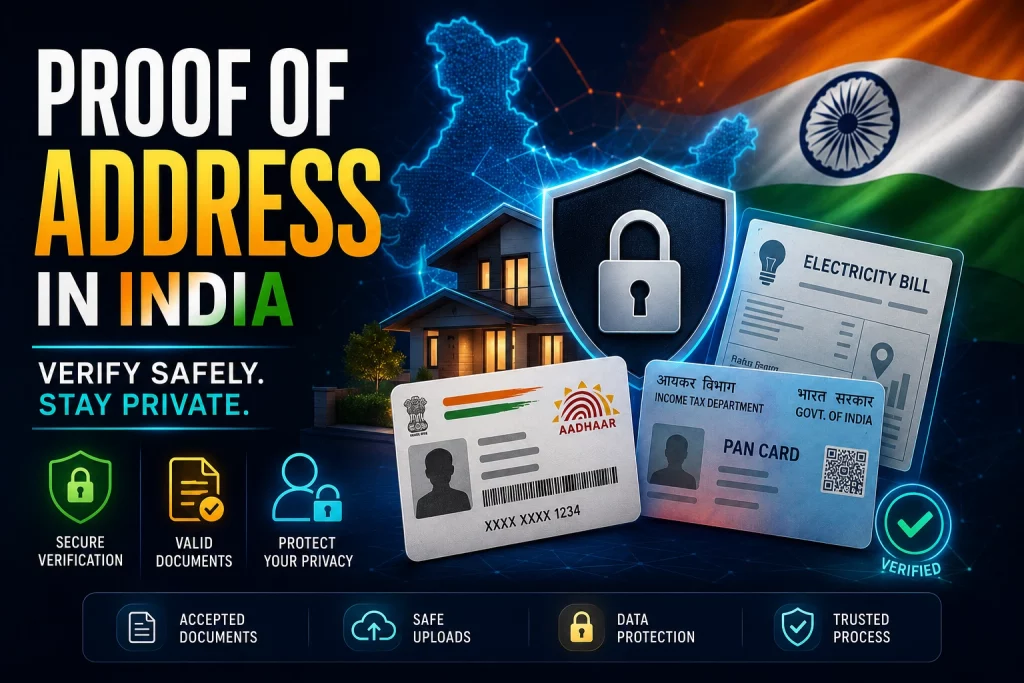
Why Proof of Address Requires Extra Care
Address verification creates a different kind of risk from ordinary account data. A name or email address can be changed or replaced more easily than a residential record. A proof of address document may show where a person lives, which bank they use, which service provider they rely on, and sometimes details about family members or household connections.
This is why document minimisation matters. A responsible platform should not ask for a broader document than necessary. It should explain whether the user can hide unrelated transaction lines, account balances, customer numbers, QR codes, or other sensitive details that are not needed for address confirmation. When no masking guidance is provided, the user may accidentally disclose too much.
Indian users should also remember that proof of address is often used in regulated financial contexts, but gambling-related websites may not always follow the same standards, oversight, or complaint routes as banks or official financial institutions. RBI’s KYC material explains recognised address-document concepts for regulated entities, while Indian cyber-safety guidance warns users to treat personal-document sharing carefully online.
Address Document Safet Review
What Indian Users Should Check Before Sharing Address Proof
Before uploading a proof of address document anywhere online, users should check whether the request is specific, proportionate, and clearly explained. A vague instruction such as “upload address proof for verification” is not enough. The platform should identify acceptable document types, explain whether the address must be current, and clarify how the document will be reviewed.
Users should also check whether the site gives any guidance on hiding unnecessary details. A bank statement, for example, may confirm address but may also expose spending patterns, account balances, transaction references, and third-party names. If the platform does not explain what can be masked, the user may overshare without realising it.
The safest approach is to treat proof of address as sensitive identity material. It should not be uploaded because of urgency, pressure, promotional language, or a fear of losing account access. If the platform links address verification to a Bonus claim or time-limited offer, users should be especially cautious, because privacy decisions should not be driven by marketing pressure.
Address Documents and Risk Levels in India
Proof of address is not a single document type. It can appear in different forms, and each form carries a different privacy risk. A simple utility bill may confirm residence, but it can also show account numbers, service-provider details, billing cycles and household information. A bank statement may show an address, but it may also reveal financial behaviour that has nothing to do with verification. This is why Indian users should evaluate the document itself before thinking about upload.
The safer question is not “which document will be accepted fastest?” but “which document exposes the least unnecessary information?” A privacy-aware review process should allow users to understand the minimum requirement. If a platform only needs address confirmation, it should not create pressure to reveal unrelated banking activity, full account history, or excessive identity details.
This point matters when users move from general account browsing to document submission. A Sign up process may feel simple at first, but proof of address can introduce a much deeper privacy layer. Users should not assume that a quick registration flow means the later document-handling process is equally transparent.
How to Interpret Document Exposure
The chart does not mean one document is always safe and another is always unsafe. It shows a practical risk pattern. A bank statement often has higher exposure because it may reveal account activity, transaction references, balances, branch information and third-party names. A utility bill may be more limited, but it can still reveal customer numbers, supply address, billing details and household records.
Aadhaar-linked records need particular caution because they can connect address information with broader identity data. Users should not share such material unless the purpose is clear and the platform provides serious privacy explanations. The same applies to rent agreements, which may reveal landlord details, signatures, family information and exact residential terms.
A platform that handles proof of address responsibly should provide guidance before upload, not after. It should explain whether partial masking is allowed, what details must remain visible, and how long the file may be stored. Without that information, the user is left to guess, and guessing is not acceptable when personal documents are involved.
Mobile Uploads and Document Oversharing
Mobile upload flows can create a false sense of simplicity. When a platform lets users take a quick photo from a phone, the process may feel casual, even though the document is sensitive. This is especially relevant for an Apк or mobile-optimised account area, where verification screens often appear compact and fast.
The risk is that users may upload a full unedited document without checking what else appears in the image. A photo may include background objects, extra pages, QR codes, address lines, account numbers, barcodes, handwritten notes or other household information. A file that was intended to confirm residence can accidentally reveal far more.
A good platform should slow this process down with clear instructions. It should tell users what must be visible and what does not need to be shown. It should avoid vague upload prompts and avoid designing verification as a one-tap action with no context. Convenience is useful only when it does not weaken privacy.
Why Address Proof Should Stay Separate from Promotions
Proof of address should not be emotionally connected to entertainment offers, loyalty messages or promotional claims. If a website presents document upload as a way to unlock a reward, receive faster account benefits, or continue a promotional flow, the user should separate the privacy decision from the marketing message.
Address documents are not ordinary account preferences. They are long-term identity records. A user can ignore an offer, leave a page, or change communication settings, but once an address document is uploaded to a weak service, control becomes harder. That is why serious platforms keep verification language neutral and factual.
For EN 365 readers in India, this distinction helps maintain safer judgment. Address verification should be evaluated by privacy clarity, legal awareness, support quality and proportionality. It should not be evaluated by urgency, reward language or visual polish.
Address Consistency, Account Records and User Control
Proof of address checks can become complicated when a platform compares the uploaded document with existing account records. The user may have entered one address during registration, used a different billing address for a payment method, or recently moved to a new residence. In these cases, the issue is not only whether the document is accepted. The more important point is whether the platform explains how address differences are reviewed.
A reliable review process should be predictable. It should clarify whether the address must match the account profile, payment method, identity document, or current residence. It should also explain what happens if a user has recently changed address. Without this information, proof of address becomes a guessing game, and users may upload unnecessary files while trying to solve a problem they do not fully understand.
This is especially important when a platform offers broad entertainment sections such as Slots or casino-style content but gives limited information about account verification. Game access and document review should not feel like the same type of interaction. Browsing content is low-friction; submitting proof of address is a privacy-sensitive decision that requires clearer rules.
Why Recent Address Changes Need Clear Handling
A recent address change can create confusion during verification. A user may have moved to a new city, changed rental accommodation, updated a bank address, or still have older documents connected to a previous residence. If the platform does not explain how these cases are handled, users may feel forced to submit several documents at once, increasing unnecessary exposure.
A transparent process should separate normal address updates from suspicious activity. Moving house, updating a bank profile, or using a temporary address is not automatically a risk signal. The platform should explain what proof is needed and avoid broad document requests that collect more information than necessary.
For Indian users, this point is practical because address records may not update everywhere at the same speed. A mobile bill, bank statement, Aadhaar-linked record, rental paper and utility bill may show different address versions during a transition period. A platform that cannot explain how it handles this situation may not be suitable for sharing sensitive documents.
Payment Address and Residential Address Are Not Always the Same
Some verification systems compare payment details with residential information, but these records do not always match perfectly. A user may use a family billing address, a workplace-linked account, a bank account registered at an older residence, or a mobile number connected to a previous address. These mismatches should be reviewed carefully, not treated as automatic failure.
The risk comes when a platform asks for extra documents without explaining the mismatch. A user may then upload more bank records, more ID files, or more address proofs in the hope of resolving the issue quickly. That behaviour can create larger privacy exposure than the original verification request.
A better review process explains what specific mismatch exists and what limited proof is needed. It should not demand broad personal records without context. When platforms communicate clearly, users can respond with less data and more confidence. When they communicate poorly, users may overshare because they do not know what the reviewer actually needs.
Address Proof and Safer Account Navigation
Proof of address content should be connected to safer account education, not only to account completion. A strong information page helps readers understand when a document request is reasonable, when it is excessive, and what privacy signs deserve attention. It should also make related safety pages easy to find without pushing users toward rushed action.
On an EN 365 page, address-verification guidance can naturally connect to internal sections about account protection, responsible use, privacy review, payment safety and general Games information. The internal link should feel useful, not promotional. Readers should be able to move from entertainment content to safety content without losing the context that document sharing is a more serious step.
This is what makes the page feel like a real expert resource rather than a generic verification article. It does not simply list documents. It explains why address proof is sensitive, how mismatches happen, where users can overshare, and why support clarity matters before any upload.
Final Proof of Address Review for Indian Users
Proof of address verification should end with a careful privacy decision, not with a rushed upload. For Indian users, the central question is whether the platform has earned enough trust to receive residential information. A website may look polished, offer fast navigation, and present verification as routine, but address documents can reveal long-term personal details that are difficult to take back once shared.
A safer process explains the exact purpose of address verification, the accepted document types, the required document age, masking options, review timing, and support access. A weaker process relies on vague wording and expects users to submit files without understanding how they will be stored or reviewed. That difference should define whether the user continues or stops.
Address proof should also be evaluated separately from entertainment content. A page about FAQ topics, account basics, or general site navigation may be low-risk, but uploading residential evidence is a different level of exposure. The user should move from ordinary browsing to document sharing only when the privacy terms are clear and the request is proportionate.
How to Use the Chart as a Safety Filter
The chart separates two patterns. A transparent address review gives users clear information about purpose, accepted documents, masking rules, support, and retention. It also keeps pressure low. A weak review does the opposite. It asks users to upload sensitive residential proof without explaining enough and often combines verification with urgency.
This does not mean every platform with proof of address checks is unsafe. It means the quality of the explanation matters. A request for address proof can be reasonable in some compliance contexts, but it becomes risky when the user does not know what will happen to the document after upload.
For Indian users, pressure level is one of the strongest warning signs. If a platform frames document upload as a quick step to unlock access, continue a promotion, or avoid sudden restrictions, the user should slow down. Good verification language is neutral, precise, and documented. It does not rely on anxiety or urgency.
Document Retention and Account Closure Questions
Retention is one of the most overlooked parts of proof of address verification. Users often focus on whether a document is accepted, but the more important question is how long the file remains stored. A platform should explain whether documents are retained for compliance reasons, how long they may be kept, and whether users can request deletion or correction.
Account closure is also relevant. If a user decides not to continue with a platform, they should know whether address records remain stored and how support handles removal requests. A site that makes account creation easy but document deletion unclear should not be treated as fully transparent.
These questions also apply to general navigation pages and resource sections. If EN 365 includes a Links area with responsible-use, privacy, or official awareness resources, it should help users move toward safer information rather than only toward commercial pages. Internal navigation should support caution, not pressure.
Final Expert View on Proof of Address in India
Proof of address is not just an administrative requirement. It can expose where a person lives, which services they use, which financial records they hold, and how their identity connects across platforms. For that reason, it should always be treated as sensitive personal data.
A serious information page should not reduce address verification to a list of accepted documents. It should explain the privacy context, the risk of oversharing, the importance of document masking, the value of support clarity, and the role of legal awareness. That is what makes the content useful for Indian readers.
For EN 365, the strongest editorial position is caution-first. The page should help users understand proof of address before sharing anything. If the platform cannot explain its request clearly, proportionately, and consistently, the safer decision is to stop and reassess.






Comments