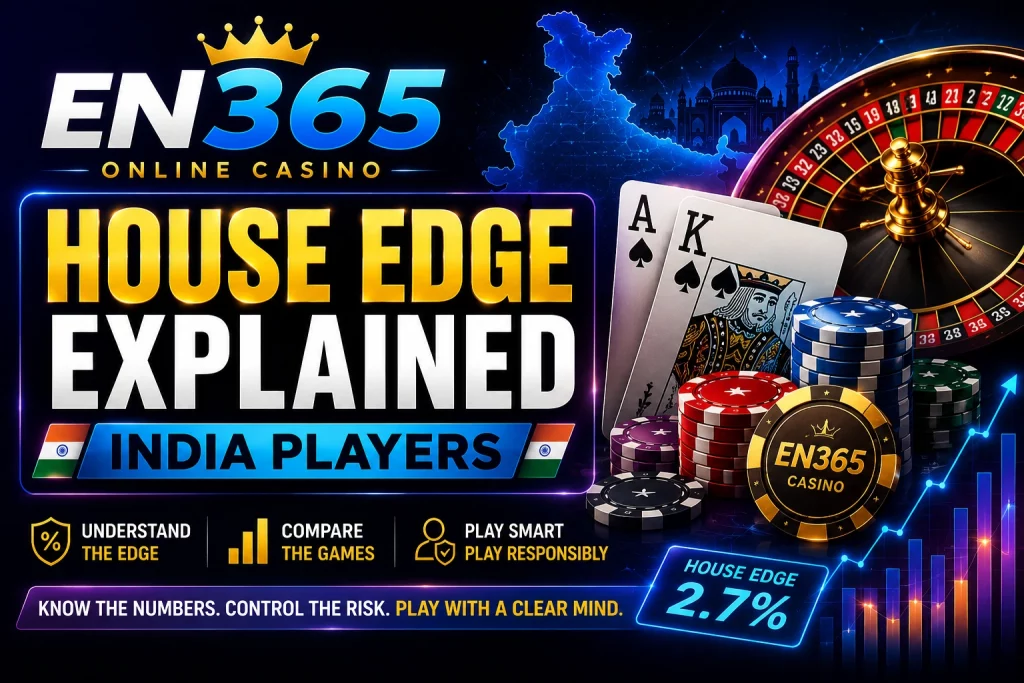
House Edge Explained for Indian Players
House edge is one of the most important concepts any Indian reader should understand before looking at casino-style games from a financial or probability-based perspective. It explains why gambling products are not designed as income tools, investment systems, or reliable ways to make money. The term describes the built-in mathematical advantage that a game operator has over the player across a long sequence of rounds. In simple terms, if a game has a house edge of 5%, the theoretical long-term return leaves 5% with the operator and returns 95% to players as a group over a very large sample of play.
This does not mean every individual session follows that percentage neatly. A player may see short-term wins, losses, or unusual streaks because gambling outcomes involve variance. However, variance does not remove the underlying structure. The longer the play continues, the more strongly the mathematical design begins to matter. That is why house edge should be treated as a risk indicator rather than a small technical detail hidden inside game rules.
For Indian players, this topic is especially important because gambling laws and access rules vary by state, product type, and platform model. A responsible explanation should not treat casino games as ordinary entertainment without context. Instead, it should clarify how probability, game rules, payout structure, and session length interact. Understanding house edge helps a reader ask better questions: How much risk does this game carry? Is the payout structure transparent? Does the game rely heavily on chance? Are the rules easy to understand before any money is involved?
Why House Edge Matters More Than Short-Term Results
Many people judge gambling games by recent outcomes. If a person wins early, the game may feel generous. If losses happen quickly, the game may feel unfair. Both impressions can be misleading because short-term outcomes are shaped by volatility. House edge works differently. It is not a prediction of what will happen in one round or even one short session. It is a long-term mathematical expectation built into the game.
For example, roulette, blackjack, baccarat, slots, crash-style games, and live dealer titles can all have different house edge levels. Even within one category, the number can change depending on rules. A blackjack table with player-friendly rules may carry a lower theoretical edge than a version with restrictive payout conditions. A slot-style game may show a return-to-player percentage, but that does not guarantee steady returns. The percentage is usually calculated over a very high number of spins, not over a casual session.
This is why house edge should be understood as a structural cost of participation. It is similar to knowing the fee, margin, or built-in disadvantage before entering any risk-based activity. The lower the house edge, the less expensive the game is in theory over time, but “lower” does not mean “safe” or “profitable.” It only means the expected long-term loss is smaller compared with a game that has a higher mathematical edge.
Core House Edge Comparison for Common Game Types
The table below is designed as an educational comparison. The exact numbers vary depending on rules, provider settings, payout models, and jurisdiction. It should not be read as a guarantee of results.
| Game Type | Typical House Edge Range | Risk Level | What Indian Readers Should Notice |
|---|---|---|---|
| Blackjack with favourable rules | Around 0.5%–2% | Lower theoretical edge | The edge depends heavily on rules and decision quality, but chance still controls outcomes. |
| Baccarat banker bet | Around 1%–1.2% | Lower theoretical edge | Simple rules do not remove risk; repeated betting still exposes the bankroll to long-term loss. |
| European roulette | Around 2.7% | Medium theoretical edge | The single zero makes it less costly than double-zero versions, but it remains mathematically negative. |
| American roulette | Around 5.26% | Higher theoretical edge | The extra zero increases the operator advantage compared with European-style roulette. |
| Slot-style games | Often 3%–10%+ | Medium to higher theoretical edge | RTP is long-term and does not promise stable returns during short sessions. |
How the Percentage Works in Real Terms
A house edge percentage becomes easier to understand when it is translated into expected value. If a game has a 5% house edge and a player stakes ₹1,000 across many rounds, the theoretical long-term expected loss is ₹50. This does not mean exactly ₹50 will disappear in one session. It means the game is mathematically structured so that, across a sufficiently large number of comparable outcomes, the operator retains that percentage from total stakes.
This distinction matters because many players focus on balance changes rather than total amount wagered. Someone may deposit ₹1,000, place many small bets, recycle winnings, and eventually wager far more than the original deposit. House edge applies to total wagering volume, not only to the first amount added to the account. A small edge can become meaningful when repeated many times.
For this reason, session length and bet frequency are central to gambling risk. A fast game with a moderate house edge can create more financial exposure than a slower game with a similar edge. The mathematics does not only depend on the percentage. It also depends on how often the player is exposed to that percentage.
Visual Example of Expected Loss by House Edge
The chart below shows a simple educational comparison using ₹10,000 as total wagering volume. It is not a prediction of personal results. It only demonstrates how different house edge levels change the theoretical long-term expected cost.
House Edge Is Not the Same as RTP
House edge and RTP are closely connected, but they are often discussed from opposite sides. RTP means return to player. If a game has 96% RTP, the house edge is usually 4%. This is a simplified way to read the numbers: 100% minus RTP equals theoretical operator advantage. However, the figure still belongs to long-term modelling, not personal prediction.
A common misunderstanding is to assume that a 96% RTP game will return ₹960 from every ₹1,000 wagered in a short session. That is not how random distribution works. One person may lose quickly, another may win temporarily, and another may experience a long flat period. RTP describes the model across very large samples, not a personal guarantee.
This is particularly important for slot-style products because volatility can be high. A game may have a relatively standard RTP but still produce uneven outcomes due to bonus rounds, rare features, or prize distribution. Two games with similar RTP can feel completely different because one pays small amounts frequently while another concentrates value into rare events. House edge explains the long-term margin, while volatility explains how rough or uneven the journey can feel.
A Responsible Way to Read Casino Mathematics
The most useful approach is to read house edge as a warning label. It tells the reader that the game is structurally negative over time. Some games may be less expensive in theory, but none should be treated as a financial plan. For Indian readers, this is especially relevant because online gambling access can be legally complex and financially risky. Local rules, platform licensing, payment protection, and responsible gambling safeguards should always be considered before any gambling-related decision.
A serious casino information page should not present house edge as a trick to “beat the system.” It should explain that no betting pattern can erase a built-in mathematical advantage. Systems based on increasing stakes after losses, chasing previous results, or assuming that a game is “due” to pay are not reliable. They can increase exposure and create larger losses.
House edge is therefore best understood as a tool for caution. It helps readers compare games, recognise risk, and avoid exaggerated claims. The lower the edge, the better the theoretical conditions, but the safest financial decision is always not to treat gambling as a source of income.
How House Edge Connects with Player Decisions
House edge is fixed by the structure of the game, but the practical effect on a player depends on behaviour. This is where many Indian readers misunderstand the topic. A game may have a published theoretical edge, yet the final risk level also depends on bet size, speed of play, session length, and whether the player changes decisions under pressure. The mathematical edge does not need to be high to become expensive if the player repeats bets quickly.
A simple example makes this clearer. A 2% edge on ₹500 of total wagering is small in theoretical terms. The same 2% edge on ₹50,000 of total wagering becomes much more meaningful. The percentage did not change, but the exposure changed. This is why responsible bankroll thinking should focus on total amount wagered, not only on the amount first deposited. Many gambling sessions feel smaller than they really are because funds move back and forth between balance, winnings, losses, and repeated stakes.
For EN 365 readers, the important point is not to search for a “perfect” game, because every casino-style product still carries risk. The better approach is to understand what the game is charging mathematically for participation. A lower edge may offer better theoretical conditions, but it does not remove uncertainty. A high-volatility game can still create sharp balance swings, even when the long-term return looks normal on paper.
Why Betting Systems Do Not Remove the Edge
Betting systems are often presented as if they can control random outcomes. Some systems suggest increasing stakes after losses. Others recommend lowering stakes after wins, splitting wagers, or following visible streaks. These methods can change the shape of a session, but they do not change the underlying house edge. If the game has a built-in mathematical advantage for the operator, changing stake patterns does not reverse that structure.
The main danger with betting systems is psychological. They can create the feeling of control where no real control exists. A player may believe that a loss is temporary because a recovery bet is planned. If the next result also loses, the required stake may rise quickly. This can turn a small entertainment session into a high-risk financial pattern. The house edge remains active on every wager, and larger wagers simply increase the amount exposed to that edge.
A useful way to read gambling mathematics is to separate decisions from outcomes. In a game like blackjack, decisions may affect the final house edge because strategy matters. In a roulette-style game, the player’s number choice does not reduce the mathematical disadvantage. In slot-style games, the player usually has no control over the result after the stake is placed. These differences matter more than any betting pattern.
The house edge is already part of the game rules before any result appears. A clear limit matters more than confidence in one round.
Short-term wins or losses can feel meaningful, but they do not prove that the game is loose, tight, fair, or unfair.
The edge applies to total wagered amount. Reusing the same balance across many rounds can create much larger exposure than expected.
Increasing stakes to recover losses does not reduce the house edge. It usually increases the amount placed under the same disadvantage.
A responsible review looks at time spent, total wagers, emotional state, and whether the result affected future decisions.
Rules, RTP notes, payment terms, and responsible play pages should be reviewed before making assumptions about any casino-style product.
The Role of Game Speed in Expected Loss
Game speed is one of the most underestimated parts of house edge. A slow game and a fast game may have similar theoretical percentages, but the faster game can produce more total wagering in less time. If a player places more rounds per minute, the same mathematical edge has more opportunities to operate. This is why speed, autoplay settings, instant repeat buttons, and rapid mobile interfaces can increase practical risk.
For example, a table game may move slowly because decisions, dealing, and settlement take time. A slot-style product may process many rounds far faster. If a player does not track total turnover, the session can feel casual while the mathematical exposure grows quickly. The visible balance is not always enough to understand the real cost of participation.
This is where an educational FAQ page can be useful if it explains game rules, RTP, volatility, and responsible limits clearly. However, information should not be treated as a promise of safety. Even the most transparent game remains a negative-expectation product when the house edge is above zero. Clear information helps with understanding, but it does not change the probability model.
Why Volatility Can Hide the Edge
House edge and volatility are different concepts. House edge describes the long-term mathematical advantage. Volatility describes how uneven the outcomes can be. A low-volatility game may return small results frequently, creating a smoother session. A high-volatility game may produce long dry periods and occasional larger wins. Both can still have the same theoretical edge.
This difference is important because volatility can hide the cost of the game. A player may experience several small wins and feel that the game is performing well. Another player may lose quickly and feel the game is unusually harsh. In both cases, the house edge may be identical. What changed was the distribution of outcomes, not the long-term structure.
High volatility can also encourage poor decisions. When wins are rare but visually emphasized, players may focus on the possibility of a large result rather than the probability of reaching it. The mathematics of the game may be clear in theory, but the emotional design of gambling products can make risk feel smaller than it is. Indian readers should therefore treat volatility as a separate risk layer, not as entertainment style alone.
Reading Platform Information Without Being Misled
A serious reader should look beyond surface labels. A platform may show RTP, game provider names, responsible play tools, and support pages. These details are useful, but they should be read critically. The presence of information does not automatically mean the product is suitable, affordable, or legally appropriate for every user. It simply gives the reader more material to assess.
Navigation pages such as Links can help users find rules, terms, payment information, and responsible gambling resources, but the quality of those pages matters. A good information structure should make risk details easy to find, not hide them behind promotional language. If important terms are scattered, vague, or difficult to understand, that is a warning sign.
The same applies to account and access areas. A Login page should not be the first thing a cautious reader thinks about. The better order is to understand legality, age restrictions, risk, game rules, payment conditions, and personal limits before considering any account-related action. House edge is only one part of that review, but it is the part that explains why repeated gambling is mathematically unfavourable over time.
Practical Reading of a House Edge Number
When a game lists a house edge or RTP, the reader should ask three practical questions. First, what is the percentage? Second, how quickly can the game be played? Third, how volatile are the outcomes? These three questions give a more realistic picture than any single number by itself.
A 1% edge may sound small, but if the game encourages large or repeated wagers, the exposure can still be significant. A 5% edge may sound manageable, but over many rounds it can become expensive. A game with high volatility may produce results that feel disconnected from its mathematical average for long periods. This is why house edge is best read as a long-term cost marker, not as a session forecast.
For Indian players, the responsible interpretation is simple: the number helps compare risk, but it does not make gambling financially reliable. Any claim that suggests a player can consistently overcome the edge through timing, instinct, streak tracking, or stake progression should be treated with caution. The house edge exists because the game is designed that way. No visual pattern or emotional confidence changes that design.
How Different Game Categories Change the Practical Impact of House Edge
House edge is easier to understand when it is connected to real game categories rather than treated as an abstract percentage. Two games can both be negative-expectation products, yet they may create very different user experiences. A slow card game with decisions, pauses, and visible rules usually feels different from a fast digital title where outcomes appear almost instantly. The mathematical edge is only one layer. The practical risk comes from the combination of house edge, volatility, speed, stake size, and user behaviour.
For Indian readers, this distinction is important because casino-style products are often presented through broad categories: table games, live games, crash-style games, card games, and Slots. These labels are useful, but they do not automatically explain the true risk profile. A player may see a familiar game name and assume the experience is predictable, while the actual version may use different rules, different payout tables, or different volatility settings.
A responsible reading starts with the mechanics. Does the game allow meaningful decisions, or is every result fully random after the stake is placed? Are payouts fixed and easy to calculate, or are they hidden behind feature rounds and rare outcomes? Does the game move slowly enough for the user to pause, or does it encourage repeated play? These questions matter because the house edge becomes more powerful when the game structure encourages high turnover.
Decision quality can affect the final edge, but the game remains uncertain. Poor rule sets, side bets, and emotional decisions can increase real risk.
The edge is mostly built into the wheel structure. Number choice, colour choice, and visible streaks do not change the mathematical disadvantage.
RTP may look clear on paper, but volatility and fast repeat play can make short sessions unpredictable and financially uneven.
The slower pace may help some users pause, but presentation, chat, and table atmosphere can still encourage longer sessions.
Simple rules can hide high emotional pressure. The decision to cash out may feel strategic, but the underlying outcome remains uncertain.
Why Fast Games Can Make a Small Edge Feel Larger
A small house edge can still become costly when the game moves quickly. This is one reason fast digital gambling products require careful attention. The percentage may look moderate, but the number of decisions per minute can be high. If a user repeats rounds without tracking total turnover, the real exposure becomes larger than the original balance suggests.
This is especially relevant in mobile-first environments. A clean App interface can make navigation easier, but it can also reduce friction between one round and the next. Smooth design is not automatically harmful, yet it does change the rhythm of play. When every action is quick, the user has fewer natural pauses to reconsider the session. From a risk perspective, pauses are useful because they interrupt automatic behaviour.
Game speed also affects emotional perception. A slow loss may feel manageable because each decision is visible. A rapid sequence of small losses may be harder to notice until the balance has changed significantly. The house edge did not suddenly become larger, but the user experienced more rounds in less time. This is why responsible gambling guidance often focuses on limits, cooling-off tools, and session reminders rather than only on game percentages.
How Bonus Conditions Can Change Real Cost
House edge should not be read separately from promotional conditions. A Bonus may appear to increase available balance, but wagering rules can change the real cost of play. If a promotion requires repeated wagering before funds become withdrawable, the player may need to expose a much larger amount to the house edge than expected. This is not only a promotional detail; it is a mathematical issue.
For example, a wagering requirement can multiply turnover. If the requirement is high, the player may need to place many rounds before meeting the condition. During those rounds, house edge and volatility remain active. Even if the starting balance looks larger, the path to completing the requirement may involve substantial risk. That is why bonus terms should be read as part of the house edge discussion, not as a separate marketing section.
Another issue is game contribution. Some games may count fully toward wagering, while others may count partially or not at all. This can push users toward faster or more volatile game types. A responsible reader should check whether a promotion changes game choice, stake size, or session length. If it does, then it changes practical exposure.
Why Sign-Up Decisions Should Come After Risk Review
A Sign up process should never come before understanding the product. From a responsible perspective, the order matters. A reader should first review legality, age rules, payment terms, game mechanics, RTP information, responsible play tools, and account closure options. Only after those details are understood can the person make an informed decision about whether the product is appropriate.
This is especially important in India because regulation is not uniform across every state and every product type. Some games are treated differently depending on whether skill or chance is involved, and online access does not automatically mean that every activity is appropriate or lawful for every user. A careful reader should avoid assuming that availability equals suitability.
House edge sits at the centre of this review because it explains the long-term cost of the activity. A platform may look polished, the interface may be smooth, and the game library may be wide, but none of that removes the mathematical structure. The edge remains part of the rules, and every repeated wager gives that edge another opportunity to operate.
Games With Decisions and Games Without Decisions
Not all Games give the player the same type of involvement. Some games include decisions that can affect the theoretical edge. Blackjack-style games are the clearest example, because rule knowledge and decision quality can change expected outcomes. However, even there, the player does not control the cards. Better decisions can reduce disadvantage, but they do not remove chance.
Other games give the impression of choice without changing the mathematics meaningfully. Choosing a roulette number, selecting a slot line, or stopping a visual animation does not usually improve expected value. These actions may make the experience feel personal, but they do not alter the random model behind the result. This difference is important because perceived control can encourage longer play.
A useful rule is simple: if the decision does not change the probability or payout structure, it probably does not reduce the house edge. Visual involvement should not be confused with mathematical influence. Responsible content should make that distinction clear because it protects readers from overestimating their control.
The Safer Interpretation of House Edge
The safest interpretation is not “find the lowest edge and play more.” The safer interpretation is “understand the cost and reduce exposure.” A lower edge may be preferable for comparison, but the most meaningful protective actions are limiting session time, limiting total stakes, avoiding loss chasing, reading terms, and not treating gambling as income.
House edge is not a secret trick. It is a structural feature of casino-style products. When readers understand it properly, they are less likely to believe in guaranteed systems, lucky timing, or recovery strategies. They can see the game for what it is: an entertainment product with a built-in mathematical disadvantage.
For EN 365 readers in India, this educational approach is more useful than promotional language. A trustworthy page should explain that house edge, RTP, volatility, and turnover all work together. The goal is not to make risk look harmless. The goal is to make the risk visible before any decision is made.
How to Use House Edge as a Final Risk Filter
House edge becomes most useful when it is treated as a final risk filter, not as a promise of better outcomes. A player may compare game categories, read RTP figures, check volatility notes, and review platform terms, but the central question remains the same: how much mathematical disadvantage is attached to each repeated wager? If that question is ignored, the rest of the review becomes incomplete.
For Indian readers, a responsible review should also include legal and financial context. Online casino-style products are not regulated uniformly across India, and availability does not automatically mean suitability. A platform may offer smooth access, many payment options, or polished game pages, but those features do not remove the risk created by chance-based outcomes. House edge is the clearest reminder that the product is built around long-term operator advantage.
This does not mean every game carries the same level of risk. A slow game with transparent rules and a low theoretical edge is different from a fast game with high volatility and unclear terms. However, the safest interpretation is still cautious: house edge can help compare risks, but it cannot turn gambling into a reliable financial activity. It should help readers reduce exposure, not justify longer sessions.
A clear RTP or house edge figure gives the reader a starting point for understanding the long-term cost of the game.
Two games can have similar RTP but different payout patterns. Volatility explains how uneven the session may feel.
Fast rounds can increase total exposure quickly. The house edge applies to turnover, not only to the first deposit.
Promotional rules can force higher turnover before withdrawals. This may increase contact with the same mathematical edge.
Limits are useful only when set before emotion enters the session. They should cover money, time, and repeat decisions.
Indian gambling rules vary by state and product type, so local context should be reviewed before any gambling-related decision.
Why Legal Context Should Stay Close to the Mathematics
House edge explains the financial structure of a game, but it does not answer whether a person should access the product. For Indian readers, legal context must remain close to any casino education page because regulation can differ by state, game type, and platform model. Some products may be positioned as skill-based, while others rely mainly on chance. This distinction can affect how the activity is viewed legally and practically.
A careful reader should avoid assuming that an online product is acceptable simply because it is reachable from a mobile browser. Availability is not the same as local suitability. This is why a responsible page should encourage legal awareness, age compliance, and caution around payment methods. The mathematics of house edge already shows that repeated play is unfavourable over time; legal uncertainty adds another layer of risk.
The stronger approach is to treat gambling information as educational rather than promotional. A reader who understands house edge, volatility, turnover, and legal variation is less likely to make rushed decisions. In that sense, mathematical education supports consumer protection because it makes hidden costs easier to see.
The Problem with Chasing Losses
Loss chasing is one of the clearest examples of house edge becoming more dangerous through behaviour. The original game may have a fixed mathematical structure, but the player changes the exposure by increasing stakes or extending the session after losses. This does not reduce the disadvantage. It simply gives the same disadvantage more money and more time to operate.
The emotional logic of chasing losses is easy to understand. A player may feel that a recovery is necessary to make the session “even” again. The problem is that random outcomes do not remember previous results. A losing sequence does not create a guaranteed correction. A winning result may happen, but it is not owed by the game. Each new wager is still governed by the same rules and the same long-term edge.
This is why responsible gambling tools matter. Deposit limits, session reminders, cooling-off periods, and self-exclusion options are not decorative features. They are protective barriers against escalation. If a reader notices that decisions become more aggressive after losses, the safest action is to stop, not to continue searching for recovery.
How to Read EN 365 Content Responsibly
For an information page like this, the purpose should be clarity. EN 365 can explain house edge in a way that helps readers understand risk before they interact with any casino-style product. The content should not suggest that lower-edge games are safe, that bonuses remove risk, or that systems can defeat probability. The honest position is that house edge is a permanent feature of the model.
This also means that readers should treat numbers carefully. RTP, house edge, and volatility are useful only when understood together. A game with a low edge can still create large losses if stakes are high or the session is long. A game with a high edge can become even riskier when paired with fast gameplay. A promotion can increase exposure if wagering requirements force repeated betting.
The best use of house edge is comparison and caution. It helps identify which games are more expensive in theory, which terms deserve more attention, and which behaviours increase harm. It is not a tool for predicting short-term wins.
Responsible Gambling Signals Readers Should Notice
Responsible gambling signals should be visible before any account decision. Clear age restrictions, limit tools, self-exclusion access, transparent terms, and support information are all part of a safer information environment. If these details are hard to find, vague, or presented only after promotional content, that should be treated as a concern.
Readers should also notice how a platform describes risk. If the language focuses only on excitement, rewards, jackpots, and lifestyle imagery, the page may not be giving enough weight to mathematical disadvantage. A trustworthy resource should explain both entertainment and risk, but risk should not be hidden behind design or promotional wording.
A clear responsible gambling message should state that gambling is not a way to earn income, recover financial pressure, or solve personal problems. It should also encourage breaks, limits, and independent help if play becomes difficult to control. House edge education supports that message because it shows why the activity is structurally risky even before emotional factors appear.
Final House Edge Takeaway for Indian Readers
The most important takeaway is simple: house edge is the built-in long-term advantage held by the operator. It does not predict one session, but it explains why repeated gambling is mathematically unfavourable. Short-term wins can happen, but they do not remove the structure. Losses can happen quickly, and chasing them can make the same edge more damaging.
Indian readers should use house edge as a caution tool. Before trusting any casino-style product, they should review the rules, RTP, volatility, speed, wagering conditions, payment terms, responsible gambling tools, and local legal context. None of these details should be skipped because each one changes the practical risk.
A responsible EN 365 page should therefore present house edge without hype. The value of the concept is not that it helps someone win. Its value is that it helps someone understand the cost of risk before making decisions.






Comments