
Responsible Gambling India Guide
Responsible gambling means treating gambling-related content as a risk area, not as a financial opportunity. For Indian readers, this topic is especially important because India’s online gaming framework has changed sharply, with the Promotion and Regulation of Online Gaming Act, 2025 prohibiting online money games and creating a national regulatory structure for permitted online gaming categories.
A responsible guide should not present gambling as a shortcut to income, entertainment without consequences, or a normal way to recover losses. The safer interpretation is direct: any product involving stake, chance, uncertainty, or financial exposure can create harm if limits, legal context, and personal control are ignored.
Responsible gambling also means recognising that technical features do not remove risk. A game may have polished graphics, fast loading, account tools, or published rules, but these details do not change the possibility of financial loss. The core issue is behaviour: how much money is exposed, how long the session lasts, whether the person can stop, and whether gambling starts affecting mood, family, study, work, or daily responsibilities.
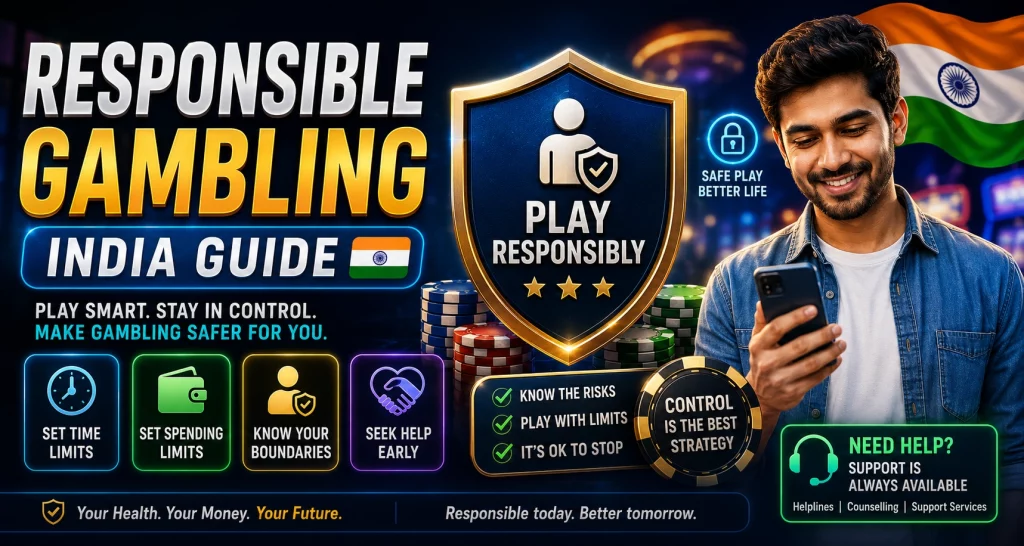
Why Responsible Gambling Matters in India
India’s current public policy direction separates permitted gaming activity from harmful online money games. Draft and official materials from MeitY discuss classification, registration, grievance redressal, compliance, and user protection within the online gaming framework.
For readers, this means responsible gambling is not only a personal habit issue. It is also a legal, financial, and consumer-protection issue. A person should not assume that a website, mobile interface, or advertised product is appropriate simply because it is accessible online.
The practical risk is simple. Gambling-related products can make money feel less real, especially when balances, points, chips, or digital wallets are used instead of cash in hand. Fast sessions can make repeated spending difficult to notice. Promotional language can make risk look smaller than it is. Responsible gambling guidance exists to slow down these decisions and make the risk visible before harm develops.
| Risk Signal | What It Can Mean | Risk Level | Safer Response |
|---|---|---|---|
| Playing longer than planned | Time control is weakening, even if spending still feels manageable. | Early caution | Set a fixed time limit and stop when it is reached. |
| Increasing stakes after losses | The session is shifting from entertainment to recovery behaviour. | Moderate risk | Stop the session and avoid trying to win back money. |
| Borrowing or using essential money | Gambling is affecting financial safety and daily needs. | High risk | Stop immediately and speak with a trusted adult or qualified support service. |
| Hiding activity from family | The behaviour may already be causing shame, conflict, or loss of control. | High risk | Be honest with a trusted person and avoid further spending. |
| Ignoring legal context | The person may be treating access as permission. | Moderate risk | Review official online gaming updates |
Limits Should Come Before Any Risk Exposure
Limits only work properly when they are set before emotion enters the situation. A person who decides on a money limit after losses has already started negotiating with pressure. A responsible system should encourage limits before any risky activity begins: a spending limit, a time limit, and a rule that losses will not be chased.
The most important limit is not the largest amount someone can afford to lose. It is the amount that can be lost without affecting food, transport, rent, education, family duties, savings, or emotional stability. If losing the money would create stress, the limit is too high.
Responsible gambling also requires time limits. Long sessions make repeated decisions feel normal. The more time a person spends inside a gambling-like environment, the easier it becomes to justify one more round, one more deposit, or one more attempt to recover. Time control is therefore not a small detail. It is one of the main protective tools.
Why Loss Chasing Is a Serious Warning Sign
Loss chasing means continuing because previous losses feel unacceptable. It is one of the clearest signs that gambling has stopped being controlled entertainment. The logic feels persuasive in the moment: one win could repair the session, one more attempt could bring the balance back, one larger stake could recover the earlier result. In reality, this usually increases harm.
Random outcomes do not owe recovery. A previous loss does not make the next result more likely to be favourable. When someone increases stakes after losing, they are not correcting the mathematics. They are placing more money under the same uncertainty.
A responsible guide should state this plainly. If the reason for continuing is “I need to get back what I lost,” the session should stop. That is not strategy. It is risk escalation.
Why Fast Access Can Increase Risk
Speed changes behaviour. A person who must pause, think, leave a room, or physically handle money has more time to reconsider a decision. Digital gambling environments reduce those pauses. Quick balance updates, rapid session flow, automatic reloads, and mobile-first interfaces can make repeated spending feel smaller than it really is.
This matters because risky behaviour often grows gradually. A person may begin with small amounts and short sessions, then slowly increase both without noticing the pattern. The faster the environment becomes, the harder it is to recognise emotional decision-making. Responsible gambling tools are designed to interrupt this acceleration and return attention to reality: time spent, money lost, and emotional state.
A responsible guide should therefore discuss design, not only personal discipline. Human attention is affected by speed, repetition, sound, animation, and constant availability. Safer systems reduce pressure rather than increasing it.
Financial limits should be decided before any gambling-related activity begins, not after emotional pressure appears.
Trying to recover losses with larger or repeated stakes is one of the clearest signs of escalating risk.
Money needed for daily life, education, rent, food, or family obligations should never be exposed to gambling risk.
Long uninterrupted sessions reduce awareness and increase the chance of repetitive emotional decisions.
Fast mobile access and repeated notifications can make gambling behaviour feel automatic instead of deliberate.
Speaking to a trusted adult, counsellor, or support service early is safer than waiting for financial damage to grow.
Why Account Access Should Support Safer Behaviour
A Login area should support awareness rather than encourage constant return. Useful account sections include spending history, time tracking, self-exclusion settings, session reminders, and cooling-off controls. These features are important because memory becomes less reliable during long emotional sessions.
A responsible account system should make the real numbers visible. How much money was spent, how long the session lasted, how many deposits were made, and how often activity occurred should be easy to review. Hidden or confusing records weaken user awareness.
This is also where responsible design matters. Fast interfaces can reduce reflection time. If every action is built around speed and repetition, users are more likely to continue automatically instead of consciously deciding whether to stop.
Why Promotional Language Requires Caution
A Bonus should never be interpreted as free money or guaranteed value. Promotional offers can make risk feel smaller because they add extra balance, spins, or temporary rewards. In reality, many promotions contain restrictions, wagering conditions, time limits, or withdrawal rules.
Responsible gambling guidance should therefore treat promotional language carefully. A person who continues only because “extra value” was offered may already be making emotionally driven decisions instead of controlled ones. The safer approach is to judge risk based on the real money exposed, not on the temporary appearance of a larger balance.
A responsible guide should also explain that promotions can increase session length. People often continue longer because they feel they should “use” the offer completely. Longer sessions usually increase total exposure and reduce decision quality.
Why Registration Should Include Risk Awareness
A Sign up process should include more than account creation. It should explain age restrictions, identity checks, spending risk, data handling, and user protection tools before any activity begins. Registration should not feel like instant approval or financial opportunity.
Responsible systems make the risks visible early. They explain that gambling outcomes are uncertain, that losses are possible, and that limits are normal rather than optional. If a platform only highlights entertainment or rewards while hiding warnings deep inside terms pages, the responsible gambling layer is weak.
For India-focused content, registration should also avoid implying that simple access means legal safety. Online money gaming remains a legally sensitive area, and users should understand that accessibility is not the same as permission or protection.
How Mobile Habits Can Affect Responsible Gambling
Mobile access can make gambling-related behaviour more difficult to control because the environment is always nearby. A person does not need to travel, wait, or plan. The next session can begin from a phone within seconds. This constant availability changes risk because gambling can move from a deliberate activity into a repeated habit.
A mobile App can be useful when it shows limits, history, warnings, and account controls clearly. The problem appears when the same interface prioritises speed, animations, reminders, and quick return buttons over reflection. Responsible gambling design should make stopping as easy as continuing.
For Indian readers, mobile risk should be taken seriously. Many users already manage payments, entertainment, shopping, and social communication through phones. When gambling-like products enter that same space, financial decisions can feel casual. Responsible behaviour requires stronger boundaries: no activity during stress, no activity when tired, no activity after losses, and no spending from essential funds.
The safest limit is decided before any emotional pressure appears. It should never include rent, food, transport, study, or family money.
Long sessions reduce awareness. A time limit creates a pause before repeated decisions turn into automatic behaviour.
Trying to recover lost money is a serious warning sign. Random outcomes do not become safer after previous losses.
Extra balance, free rounds, or rewards can extend sessions and increase exposure if terms are not understood.
Support is more effective when requested early. A trusted adult, family member, counsellor, or support service can help restore perspective.
If stopping feels difficult, cooling-off, self-exclusion, payment blocking, or app blocking tools should be used without delay.
Why Game Types Should Be Judged by Risk, Not Theme
Different game types create different risk patterns. Some are slow and rule-heavy. Others are fast, visual, and highly repetitive. Some show frequent small returns. Others produce long gaps and rare larger outcomes. A responsible reader should not judge a product only by theme, design, or popularity.
Casino-style Games should be evaluated by speed, volatility, stake range, payout clarity, and whether the user can pause easily. A bright visual theme does not make a game safer. A familiar title does not reduce risk. A smooth interface does not change the mathematical structure.
The main responsible question is not “which game looks better?” but “which conditions increase my exposure?” Fast rounds, high volatility, easy repeat buttons, and emotional reactions after losses all increase risk. A serious guide should keep that focus visible.
Why Slot-Style Products Need Extra Caution
Slots often require extra caution because they combine speed, animation, sound, volatility, and unpredictable outcomes. A slot-style product can show many small returns while the balance still declines over time. It can also display large possible wins that are rare and should not be treated as normal expectations.
The risk is not only mathematical. It is behavioural. Frequent effects, near-miss designs, bonus symbols, and rapid restart options can make a user feel close to a better result. That feeling can encourage longer sessions even when the outcome remains random.
A responsible approach is to treat slot-style products as high-attention-risk content. Time limits, money limits, and strict stopping rules are essential. If the product starts to feel like something that must continue until a feature appears, the safest response is to stop.
Why Help Pages Should Be Easy to Find
A responsible FAQ should not be hidden. It should clearly explain limits, account closure, cooling-off periods, self-exclusion, payment restrictions, age rules, and signs of problematic gambling. If users cannot quickly find these answers, the safety layer is weak.
A strong FAQ should use plain language. It should avoid vague reassurance and answer direct questions: How do I set a limit? How do I close an account? What happens if I ask for self-exclusion? Where can I get help? What should I do if I cannot stop?
For India-focused content, a FAQ should also separate legal information from platform claims. Users need to know that access does not automatically mean permission, and that online money gaming can carry legal and financial risk.
Why Internal Links Should Lead to Safety Content
Internal Links should guide readers toward safety, not pressure. A responsible gambling page can link to account limits, legal context, payment safety, fairness testing, complaint handling, and support information. The purpose should be education and protection.
A weak internal linking structure pushes users toward action pages before explaining risk. A stronger structure helps them understand what to check first. This distinction matters because site architecture can influence behaviour.
For EN 365, responsible internal navigation should make safety content easy to reach from every relevant page. Users should not need to search deeply for limits, warnings, help resources, or account closure information.
Final Responsible Gambling Checks Before Any Risk
Responsible gambling becomes most useful when it is practical. A reader should not only understand general warnings; they should know what to check before money, time, emotion, or personal data become involved. The most important checks are simple: legal context, age restrictions, spending limits, time limits, emotional state, account controls, and access to support.
For Indian readers, responsible gambling also means recognising that online money gaming is a legally sensitive area. A product being available online does not automatically mean it is suitable, safe, or lawful for every user. Any page that discusses gambling-related activity should make this clear rather than presenting access as permission.
The safest approach is to treat gambling as high-risk entertainment, not as income, recovery, investment, or skill proof. If a person feels pressure to win, recover, continue, hide activity, or borrow money, the responsible choice is to stop and seek outside support.
If gambling involves rent, food, study, family money, loans, or borrowed funds, the risk level is already too high.
Secrecy often shows that gambling has started creating pressure, shame, conflict, or loss of control.
Loss chasing increases exposure and usually turns a controlled session into a high-risk financial pattern.
Long sessions reduce attention and make repeated decisions feel normal, especially during stress or fatigue.
Money and time limits should be decided before activity starts and should never be adjusted during emotional pressure.
Support works best before harm becomes severe. A trusted person or qualified service can help restore perspective.
Why Responsible Gambling Is Not Only Personal Discipline
Responsible gambling is often described as self-control, but that is only part of the topic. Good systems also reduce pressure. Clear limits, visible warnings, transparent account records, cooling-off tools, and easy access to help all support safer behaviour. If the environment is designed only to keep the user active, personal discipline becomes much harder.
This is why responsible gambling content should criticise risky design when necessary. Constant reminders, aggressive promotional wording, instant repeat buttons, and unclear terms can all increase harm. A serious guide should not pretend that risk exists only because users make poor choices. Product design and information design matter too.
The strongest responsible gambling approach combines personal limits with platform accountability. Users should protect themselves, but platforms should also make safer choices easy, visible, and normal.
When Stopping Is the Safest Decision
Stopping is the safest decision when gambling starts affecting mood, money, time, or relationships. It is also the safest decision when someone feels a strong need to recover losses, continue despite stress, or hide the activity from others. These are not small warning signs. They show that gambling is no longer controlled.
A person does not need to wait for severe harm before stepping back. Early stopping is more protective than late recovery. Taking a break, using blocking tools, closing access, or speaking to someone trustworthy can prevent the situation from becoming more serious.
A responsible guide should normalise stopping. The goal is not to play better or recover smarter. The goal is to prevent harm.
How EN 365 Should Present Responsible Gambling
For EN 365, responsible gambling content should be visible, practical, and easy to understand. It should not be hidden in a footer or written only as a legal disclaimer. It should appear near pages that discuss games, payments, bonuses, accounts, and platform access.
The tone should be direct. Gambling is not a way to earn income. Losses are possible. Chasing losses is dangerous. Borrowing money to gamble is a serious warning sign. If a user cannot stop, support should be contacted early.
A responsible site looks more trustworthy when it gives readers clear tools rather than vague slogans. Limits, account controls, cooling-off options, self-exclusion guidance, and help information should be easy to locate.
Final Responsible Gambling Takeaway for India
Responsible gambling in India should be understood through three layers: personal behaviour, platform design, and legal context. Personal behaviour covers limits, stopping rules, emotional awareness, and financial boundaries. Platform design covers visibility of controls, clear records, support routes, and reduced pressure. Legal context covers whether online money gaming activity is allowed, restricted, or prohibited.
No responsible guide should suggest that gambling is financially reliable. It is not. Random outcomes, house edge, volatility, and repeated exposure create real risk. The safest approach is caution, strict limits, and stopping early when control feels weaker.
For readers, the final rule is simple: if gambling causes pressure, secrecy, borrowing, stress, conflict, or a need to recover losses, it is time to stop and seek support.






Comments