Self Exclusion India Options
Self Exclusion India Options: Why Player Control Must Come First
Self exclusion is one of the most important responsible gaming tools available to players in India because it changes the relationship between the user and the platform. Instead of relying only on willpower, reminders, or temporary pauses, self exclusion creates a formal restriction that prevents continued access to an account for a defined period. For an EN 365 user, this matters because gambling-related decisions should never depend on mood, pressure, frustration, or the hope of recovering previous losses.
In India, the discussion around online gaming has become much stricter in recent years. The Promotion and Regulation of Online Gaming Act, 2025 introduced a national framework that prohibits online money games and places stronger emphasis on consumer protection, responsible gaming, and harm prevention. The official government note describes the law as applying across India and also to online money gaming services offered from outside India when they target users within the country.
Self exclusion should be understood as a protective barrier, not as a punishment. A player may choose it after noticing repeated deposits, emotional play, chasing losses, hiding activity, or difficulty stopping after a planned session. It can also be used earlier, before serious harm appears. The best responsible gaming approach is preventive, not reactive. Waiting until gambling creates major financial or personal damage makes recovery more difficult.
For Indian players, self exclusion options can vary depending on the platform, account structure, and local legal context. Some platforms offer direct exclusion tools inside the account area. Others require contacting support and requesting account blocking. Industry bodies such as the All India Gaming Federation describe self exclusion as a measure where user accounts are blocked to prevent further access, with remaining winnings handled according to platform terms.
A serious casino information site should explain these options plainly. It should not make self exclusion sound complicated, embarrassing, or extreme. The basic principle is simple: when play no longer feels controlled, the player should be able to stop access quickly, clearly, and without negotiation.
How Self Exclusion Works in Practice
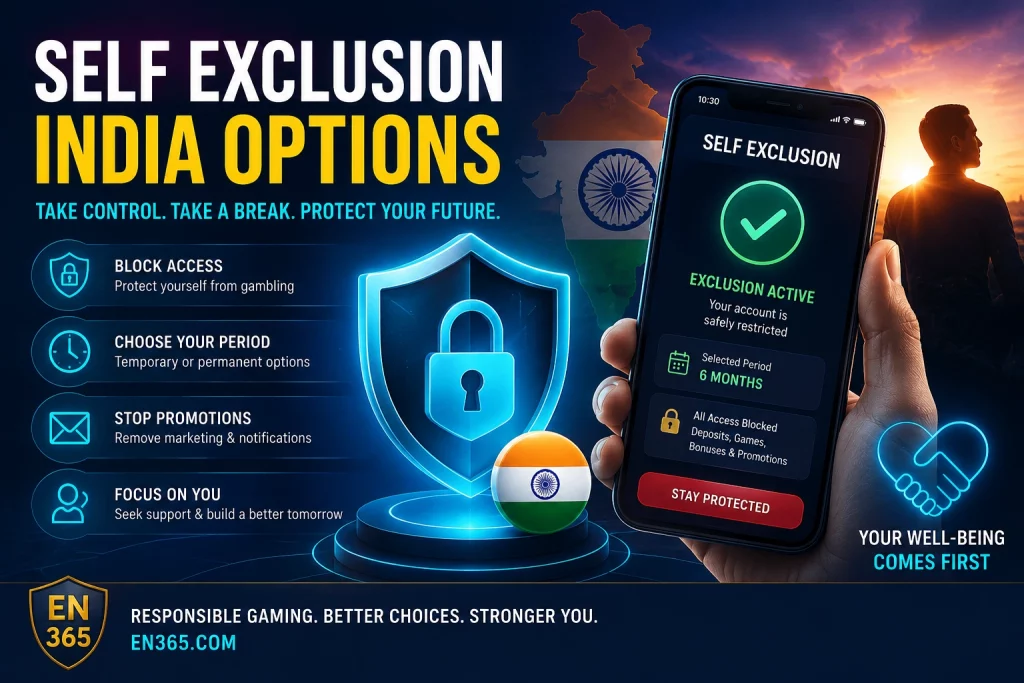
Self exclusion usually begins with a direct request from the player. The request can be made through the account dashboard, responsible gaming page, live chat, email, or support form. Once accepted, the account is restricted for the selected period. During that time, the player should not be able to deposit, play, claim promotions, or reopen the account casually.
The strongest self exclusion systems also stop marketing communication. This is important because promotional messages can trigger a return to play. A user who has self excluded should not continue receiving reminders about offers, tournaments, or account benefits. If a platform allows account blocking but continues to send promotional material, the protection is incomplete.
Before using self exclusion, a player should check whether the restriction is temporary or permanent, whether withdrawals remain possible, how pending balances are handled, and whether the decision can be reversed. In a responsible system, reversing self exclusion should not be immediate. A cooling-off delay helps prevent impulsive reactivation.
For EN 365 readers, the safest interpretation is that self exclusion is suitable whenever gambling starts to feel less like entertainment and more like a financial or emotional obligation. If logging in becomes automatic, if the Login page feels like a habit rather than a choice, or if play is used to escape stress, exclusion can be a practical step.
Main Self Exclusion Options for Indian Players
There is no single universal self exclusion register covering all Indian gambling or gaming platforms in the same way some other jurisdictions operate central exclusion systems. Because of that, users often need to act at platform level and also apply personal device, banking, and behavioural controls. This makes a layered approach more realistic.
The first layer is account-level exclusion. This blocks access to the specific platform where the user plays. The second layer is financial control, such as reducing payment access, limiting discretionary spending, or asking a trusted person for help managing risky transactions. The third layer is device control, including app restrictions, website blocking, and notification removal. The fourth layer is personal support, especially if the player feels unable to stop without help.
Self exclusion is not only for people with severe gambling problems. It can also be used after a stressful period, during exams, during financial pressure, or when a player wants a full break from gambling-style products. A temporary block may be enough for some people. Others may need a longer or permanent exclusion.
The key is to choose the option that matches the actual risk. A player who only wants a weekend break may need a cooling-off tool. A player who repeatedly loses control should not rely only on short pauses. A longer exclusion period is more suitable when the same pattern keeps returning.
The player asks the platform to block account access for a chosen period. This should stop deposits, play, promotional claims, and casual reactivation.
Best for: direct platform controlA shorter break used when the player wants temporary distance from gambling-style activity before behaviour becomes more difficult to control.
Best for: early interventionDeposit, time, and spending limits reduce exposure before exclusion becomes necessary. The E-Gaming Federation describes responsible play as helping users reduce or stop excessive gameplay.
View EGF responsible play resourceIndian industry guidance discusses user protection measures such as self exclusion, KYC, safer play controls, and support for vulnerable users.
View AIGF responsible gaming resourceWhen a Player Should Consider Self Exclusion
The clearest warning sign is loss of control. This does not always mean huge losses. Sometimes the warning sign is smaller but repeated: staying longer than planned, depositing again after deciding not to, playing while upset, checking the account too often, or feeling restless when unable to play. These patterns matter because they show that the activity is no longer fully voluntary.
Another serious sign is chasing losses. When a player continues because they want to recover money already lost, decisions become distorted. The next bet is no longer entertainment; it becomes an attempt to repair damage. This is one of the strongest reasons to use self exclusion immediately.
Players should also consider self exclusion when gambling affects studies, work, family time, sleep, or personal responsibilities. Harm is not only financial. Time loss, secrecy, anxiety, and irritability are also relevant. A person may still have money available but already be experiencing unhealthy involvement.
A practical rule is simple: if the player is asking whether self exclusion might be necessary, it is probably worth using at least a cooling-off period. Responsible gaming tools work best when used early. Waiting for certainty often means waiting too long.
EN 365 and Responsible Access
For a site like EN 365, responsible access means helping users understand both entertainment features and protective limits. A strong platform experience is not only about fast registration, smooth navigation, or a simple Sign up process. It is also about making safety tools visible, understandable, and usable without pressure.
Self exclusion information should be easy to find. It should not be hidden behind promotional content or written in vague language. A player should be able to understand what happens to the account, whether the exclusion applies immediately, how long it lasts, and how support can be contacted.
This matters especially in India, where online gaming rules have become more restrictive and consumer harm is a major public policy concern. Reuters reported that India’s 2025 lawmaking push cited addiction risk and psychological and financial harm as reasons for stronger restrictions on money-based online games.
The responsible approach is to treat self exclusion as a normal account safety feature. It should sit beside other controls such as time reminders, spending limits, account history, and support links. A player who chooses exclusion is not failing. They are using the correct tool for the situation.
Platform-Level Self Exclusion and What It Should Actually Block
Self exclusion only works properly when it blocks the full route back into play, not just one visible button. A weak exclusion tool may close the account page but still allow promotional emails, app notifications, saved payment prompts, or support-driven reopening. A stronger system removes the player from the active gambling environment and makes the return process deliberately slow.
For Indian players, this distinction is important because many users interact with gaming platforms through mobile-first behaviour. Access may happen through browser bookmarks, saved credentials, app icons, payment shortcuts, or promotional messages. If only one access point is blocked, the habit can continue through another route. A reliable self exclusion setup should therefore cover account access, deposits, gameplay, promotional participation, and direct marketing.
A player should also check whether exclusion affects all related accounts under the same operator. Some platforms run several brands, apps, or mirror-style access points. If the exclusion applies only to one account and not the wider operator system, the protection may be too narrow. This is why support confirmation is important: the player should ask exactly what is blocked and for how long.
Good self exclusion is also not meant to be negotiated after emotional pressure. If a player asks support to reopen access during the exclusion period, the platform should not treat this as a normal customer retention request. A responsible system should maintain the block until the exclusion period ends and then apply a cooling-off review before any return is possible.
Why Self Exclusion Should Include Marketing Restrictions
Marketing restrictions are not a small detail. They are central to self exclusion because promotional material can reactivate gambling behaviour. A player who blocks account access but still receives messages about a Bonus may feel pulled back into the same cycle they were trying to interrupt.
This is especially relevant when promotions use urgency, countdowns, limited-time offers, or personalised language. Even if the account is technically blocked, repeated exposure to casino-related messaging can keep the gambling habit mentally active. The safer approach is to request removal from promotional emails, SMS campaigns, push notifications, and retargeting where possible.
Players should also manually unsubscribe from emails and disable notifications on their devices. Platform-side exclusion is important, but personal environment cleanup helps reduce triggers. This includes deleting saved bookmarks, removing app shortcuts, clearing autofill login data, and blocking payment methods used only for gambling activity.
Self exclusion should create distance. That distance is not only technical; it is psychological. The fewer reminders a player sees, the easier it becomes to break the automatic loop between stress, boredom, curiosity, and gambling access.
Notice whether gambling is linked to stress, repeated deposits, chasing losses, secrecy, sleep disruption, or loss of time control.
Purpose: early recognitionSelect a cooling-off break, temporary self exclusion, long-term exclusion, or permanent account closure depending on how serious the pattern has become.
Purpose: correct protection levelAsk whether the block covers deposits, gameplay, promotions, account reopening, app access, support reactivation, and marketing messages.
Purpose: avoid partial protectionDelete shortcuts, disable notifications, unsubscribe from promotional messages, remove saved payment routes, and avoid gambling-related browsing habits.
Purpose: reduce relapse cuesSpeak with a trusted person, financial adviser, counsellor, or local support service if gambling has already affected money, mood, work, study, or relationships.
Purpose: strengthen recoveryCooling-Off Periods Compared With Full Self Exclusion
A cooling-off period is a shorter interruption. It can be useful when a player feels tired, irritated, distracted, or too emotionally involved after a session. It works best when the problem is still early and the player mainly needs distance. The account is paused, but the intention is usually temporary.
Full self exclusion is stronger. It is more suitable when the player has repeatedly failed to stop, has used money meant for other needs, has hidden gambling activity, or has returned to play after several promises to quit. In that situation, a short break may not be enough because the pattern has already become repetitive.
The choice should be based on behaviour, not pride. Some players avoid full exclusion because they feel it sounds too serious. That is a mistake. A tool should be judged by whether it protects the person, not by how it sounds. If a longer block prevents further harm, it is the correct choice.
For EN 365 readers, the practical advice is to treat cooling-off as a warning tool and self exclusion as a firm boundary. Cooling-off says, “I need space.” Self exclusion says, “I should not have access right now.” Both can be responsible choices, but they serve different levels of risk.
Mobile Access and App-Based Risks
In India, many players interact with gaming platforms through phones rather than desktop browsers. That makes self exclusion more complicated because access is faster, more private, and more habitual. A user may open an app automatically without planning to gamble. The behaviour can become part of daily phone use.
This is why the App environment needs special attention. If the platform has an installed app or shortcut, the player should remove it after activating self exclusion. Push notifications should be disabled. Saved passwords should be cleared. Payment apps connected to gambling deposits should be reviewed carefully.
Mobile-first access also increases the risk of impulsive play during emotional moments. A player can move from frustration to deposit within seconds. Self exclusion creates friction by blocking the route before the impulse becomes action.
A responsible player should not rely only on memory or intention. Device settings, app limits, notification blocks, and account exclusion all work together. The goal is not to make gambling slightly harder. The goal is to create enough distance that the player has time to think before acting.
Financial Controls That Support Self Exclusion
Self exclusion becomes stronger when it is combined with financial controls. Account blocking reduces platform access, but money management reduces the chance of moving to another gambling site, payment route, or impulse deposit. For Indian players, this is especially important because mobile payments, UPI habits, saved cards, and fast wallet access can make gambling feel almost frictionless.
A practical financial control starts with transaction awareness. The player should review recent gambling-related payments and identify patterns: repeated small deposits, late-night payments, deposits after losses, or payments made immediately after receiving salary or pocket money. These details show whether gambling is becoming reactive rather than planned.
The next step is separation. Money needed for rent, food, education, bills, family responsibilities, transport, or debt repayment should never sit in the same spending pool used for gambling. A player who struggles with control may need stronger protection, such as removing saved payment methods, lowering card limits, blocking merchant categories where available, or asking a trusted person to help supervise discretionary funds.
Self exclusion is most effective when it blocks access and reduces available gambling triggers at the same time. If the account is blocked but money remains easily available for another platform, the risk simply moves elsewhere. Financial controls close that gap.
These signs suggest that self exclusion should be supported by stronger money controls, not treated as a single isolated step.
These actions help make exclusion more effective by adding friction around payments, deposits, and impulsive spending.
Why Game Choice Can Become a Risk Pattern
Self exclusion is not only connected to how much money a player spends. It is also connected to how the person chooses and repeats certain game types. Some users return again and again to fast games because they want quick outcomes. Others prefer long sessions because they lose track of time. In both cases, the problem is not the category itself but the behaviour around it.
Fast-result products can create pressure because each round ends quickly and invites another decision. Longer sessions can also be risky because the player may stop noticing time, spending, or emotional changes. The safest approach is to observe personal patterns honestly. A player should ask: which games make me lose control faster, and which situations make me continue when I already planned to stop?
This applies to Slots as well as table formats, live games, cards, crash-style formats, and other casino-style products. A player who notices repeated loss chasing in one category should not treat that category as harmless simply because the stake seems small. Repetition can create large exposure even when individual rounds look minor.
Self exclusion can interrupt this pattern by removing access before the player enters the same loop again. Without access, the player has time to review behaviour from a distance instead of making decisions inside the session.
Behavioural Warning Signs Indian Players Should Not Ignore
Many gambling-related problems develop gradually. The player may not notice one dramatic event. Instead, small compromises begin to stack up. A planned ten-minute session becomes one hour. A small deposit becomes several deposits. A break becomes delayed. A loss becomes a reason to continue.
One warning sign is emotional dependency. If gambling becomes the main way to manage boredom, loneliness, stress, or frustration, the player is no longer using it as simple entertainment. Another warning sign is secrecy. If the player hides activity from family, friends, or partners, the behaviour already carries shame or conflict.
A third warning sign is financial distortion. This happens when gambling money is mentally separated from real money. The player may say, “It is only one more deposit,” while ignoring the total amount spent across the week or month. Reviewing the full payment history usually gives a clearer picture than relying on memory.
The strongest warning sign is repeated loss of control. If the player has tried to stop several times and returned anyway, self exclusion should be treated as a necessary protective measure rather than an optional feature.
How EN 365 Should Present Safer Play Information
An expert casino site should not present responsible gaming as a small footer link. It should be part of the user journey. Readers should understand how play works, where risk appears, and what tools can reduce harm. This is especially important for Games pages, where users often compare titles, features, volatility, and gameplay style.
Safer play information should be written in direct language. It should explain what the tool does, when to use it, and what happens after activation. The page should not use vague phrases such as “play wisely” without giving practical steps. A user in distress needs clear instructions, not decorative slogans.
EN 365 should also avoid making responsible gaming content feel separate from the rest of the site. If a guide explains deposits, bonuses, apps, or game categories, it should also explain how users can slow down, set limits, or stop access. That creates a more credible editorial structure.
The best responsible gaming content does not scare the reader, but it also does not soften the risk. It gives the user enough information to act early, before gambling becomes financially or emotionally damaging.
Support Outside the Gambling Platform
Self exclusion is a strong technical tool, but it is not always enough by itself. If gambling has already affected finances, sleep, mood, studies, work, or relationships, outside support may be necessary. This can include speaking with a trusted person, contacting a counsellor, reviewing debt or spending with a financial adviser, or using mental health support services.
Some players avoid asking for help because they think the problem must be extreme before support is justified. That is incorrect. Support is appropriate whenever gambling feels difficult to control. Early support can prevent deeper harm and reduce isolation.
A trusted person can also help with practical steps. They may help review payment records, remove gambling-related apps, block access points, or create a safer budget structure. The role of support is not to shame the player. It is to reduce the number of decisions the player has to manage alone.
For Indian players, the safest approach is layered: platform exclusion, payment friction, device cleanup, and human support. The more serious the pattern, the more layers should be used.
Long-Term Recovery After Self Exclusion
Self exclusion is most useful when it becomes part of a wider recovery plan. The account block creates immediate distance, but the player still needs a structure for the days and weeks that follow. Without structure, the same pressure points can return through boredom, financial stress, social triggers, or curiosity about gambling content.
The first stage after exclusion should be practical cleanup. The player should remove saved gambling links, disable promotional notifications, unsubscribe from emails, and avoid browsing review pages or bonus pages that may restart interest. This is not about avoiding information forever. It is about creating a clean environment while the habit is still active.
The second stage is financial review. A player should look at recent payments and calculate the full monthly impact of gambling. This can be uncomfortable, but it replaces vague memory with facts. Many users underestimate repeated small deposits because each transaction looks manageable on its own. The total amount gives a more accurate picture.
The third stage is routine replacement. Gambling often fills a time gap or emotional gap. If nothing replaces it, the old habit remains available mentally even when the account is blocked. Exercise, study time, work tasks, family activity, reading, gaming without money mechanics, or structured screen breaks can help reduce that empty space.
Check that account access, deposits, gameplay, promotions, and marketing messages are restricted. Save written confirmation from support if available.
Focus: technical protectionRemove app shortcuts, saved passwords, gambling bookmarks, payment autofill, email triggers, and notification permissions connected with gambling activity.
Focus: trigger reductionCompare previous gambling deposits with essential spending, savings goals, bills, study costs, and family responsibilities to understand the real impact.
Focus: financial clarityUse replacement activities, trusted support, spending limits, and regular self-checks to prevent the same cycle from restarting after the exclusion period ends.
Focus: long-term controlWhat to Do Before Returning After an Exclusion Period
The end of an exclusion period should not automatically mean a return to gambling. It should trigger a review. The player needs to ask whether the original reasons for exclusion have changed, whether finances are stable, whether urges have reduced, and whether gambling can genuinely remain limited.
A return is unsafe if the player still feels pressure to recover previous losses. It is also unsafe if the player plans to return immediately because of a promotion, payday, boredom, or emotional stress. These are not neutral reasons. They suggest that the same pattern may restart.
Before any return, the player should set firm boundaries. These may include a small entertainment budget, no credit-based gambling, no late-night sessions, no play during stress, and no gambling after losses. If those rules feel impossible to follow, returning is not advisable.
For EN 365 readers, the safest position is clear: self exclusion should remain active for as long as control feels uncertain. Entertainment is optional. Financial stability, mental clarity, and personal safety are not optional.
Using FAQ and Support Pages Correctly
A responsible platform should make help content visible before a player reaches crisis point. The FAQ section should explain how self exclusion works, how long it lasts, whether it can be reversed, what happens to balances, and how marketing messages are stopped.
Support information should also be written in plain language. Players should not have to decode legal wording when they are already under pressure. A clear support page should answer practical questions quickly: where to request exclusion, what details to provide, how confirmation is sent, and what other safer play tools are available.
Internal navigation also matters. Responsible gaming content should connect naturally with account guides, payment information, verification pages, and safety resources. The Links page can help if it directs users to official rules, industry guidance, support resources, and safer play information instead of only listing access routes.
The goal is not only to publish responsible gaming content. The goal is to make it usable. A player who needs help should reach the correct page in seconds, not after searching through promotional sections.
Final Responsible Gaming Position for EN 365
Self exclusion is one of the clearest signals that a gambling platform takes player safety seriously. It gives users a direct way to step away when control becomes uncertain. For Indian players, where online money gaming rules and consumer protection concerns are increasingly strict, this tool should be treated as essential.
A strong self exclusion approach has four layers: account restriction, marketing removal, financial friction, and personal support. Any one layer helps, but together they create a much stronger barrier against impulsive return. This is especially important for mobile-first users who may access gambling content quickly and privately.
EN 365 should present self exclusion as a normal, practical, and respected option. The language should be calm, direct, and useful. Players should never feel that asking for account blocking is shameful or unusual. It is a responsible decision when gambling no longer feels controlled.
The safest rule is simple: if gambling creates pressure, secrecy, financial stress, emotional instability, or repeated loss of control, self exclusion should be used early. A controlled break is always better than waiting until the damage becomes harder to repair.






Comments