
Casino Licensing Explained
Casino Licensing Explained for India
Casino licensing is the legal and compliance framework used to decide whether a gambling or gaming operator is allowed to offer services, collect money, advertise, process payments, and handle user disputes. In India, this topic must be handled carefully because the legal environment around online money games changed significantly after the Promotion and Regulation of Online Gaming Act, 2025. The Act extends across India and applies to online money gaming services offered within the country.
Licensing is not just a logo in a website footer. A real licensing framework normally defines who may operate, what products are permitted, how users are protected, whether payments can be processed, what advertising is allowed, and how complaints are handled. For casino-style products, licensing also connects to fairness testing, responsible gaming, anti-fraud controls, age verification, and payment transparency.
For Indian readers, the most important point is that access to a website does not automatically mean the product is lawful, licensed, or safe. Government communication in 2026 described the Online Gaming Act 2025 as prohibiting online money games and promoting a safer digital ecosystem. This means any licensing discussion should start with legal suitability, not with promotional claims.
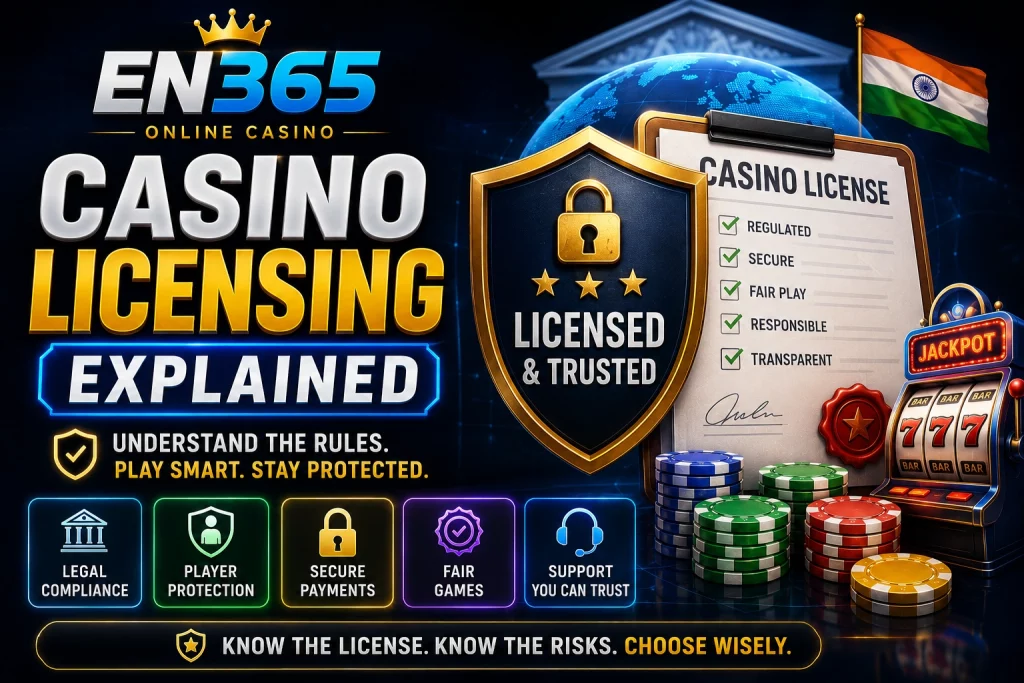
Why Casino Licensing Matters
Licensing matters because it creates accountability. Without a recognised regulatory framework, users may have limited protection if funds are frozen, withdrawals are delayed, game results are disputed, or platform terms change suddenly. A licensed structure usually requires the operator to follow rules on identity checks, complaint handling, responsible gaming, technical controls, advertising, and record keeping.
In a weak or unclear licensing environment, the burden shifts to the user. The user must guess whether the operator is legitimate, whether game results are audited, whether payment systems are reliable, and whether support will respond fairly. That is not a strong consumer-protection model. A transparent licence should reduce uncertainty by showing who supervises the operator and what obligations apply.
India’s online gaming framework is especially sensitive because public policy has focused on financial harm, addiction risk, illegal betting, and misleading promises of quick wealth. The government’s PIB note on the 2025 Bill described the legislation as a move to protect citizens from online money games while promoting and regulating other online game categories.
| Licensing Area | What It Means | Review Level | Reader Check |
|---|---|---|---|
| Legal permission | Checks whether the operator is allowed to offer the product in the relevant jurisdiction. | Critical review | Do not assume access means legality. |
| Product classification | Separates permitted online games, prohibited money games, skill-based formats, and chance-based products. | Critical review | MeitY Online Gaming Act 2025 |
| User protection | Covers age checks, complaint handling, account controls, responsible gaming tools, and user warnings. | Detailed review | Look for visible protection policies. |
| Payment oversight | Reviews whether deposits, withdrawals, refunds, and restricted balances are handled under clear rules. | Detailed review | Payment terms should be available before use. |
| Public information | Explains whether rules, ownership, terms, legal notices, and complaint routes are easy to find. | Basic review | PIB online gaming update |
Licensing Is Not the Same as Fairness Testing
Licensing and fairness testing are connected, but they are not the same. Licensing answers the legal and operational question: is the operator authorised, supervised, and required to follow specific rules? Fairness testing answers the technical question: do games behave according to their declared randomisation, RTP, and payout models?
A platform can talk about tested games while still offering weak licensing information. That is not enough. A user needs both layers to understand the risk. Technical testing may show that a game follows its declared mathematics, but licensing determines whether the operator itself is accountable to a regulator or legal framework.
This distinction is especially important in India because the current legal conversation is not only about whether games are random or fair. It is also about whether money-based online gaming activity is permitted, how users are protected, and how illegal or harmful platforms are restricted. A licensing page should therefore explain legal accountability before discussing game libraries or platform features.
Why Offshore Claims Need Careful Review
Many casino-style websites use offshore licensing language. They may refer to foreign regulators, international certificates, or company registrations outside India. These details can be relevant, but they do not automatically mean the product is lawful or suitable for Indian users. A foreign licence may supervise the operator in one jurisdiction while Indian law still treats certain online money games differently.
This is one of the most common misunderstandings in casino licensing. Users often assume that any licence is enough. In reality, licensing is jurisdiction-specific. A licence must be read in context: who issued it, what products it covers, whether it permits access from India, whether it provides complaint rights, and whether it protects local users.
A serious review should also check whether the operator clearly explains its legal position. If the site only shows a badge but does not identify the regulator, licence number, company name, registered address, complaint route, and product scope, the licensing claim is incomplete.
What a Strong Licensing Page Should Explain
A strong licensing page should explain the operator’s legal status in direct language. It should not rely only on decorative trust marks. The reader should be able to identify the company, the licence or registration claim, the regulator, the covered products, the user restrictions, the payment rules, and the complaint process.
It should also explain limitations. If a licence applies only to certain markets, that should be stated. If a product is restricted in some regions, that should be clear. If identity checks are required before withdrawals, the user should know that before any financial decision. Licensing information loses value when it appears only after a problem occurs.
For an EN 365-style educational page, the goal should be clarity. Licensing should help readers understand risk, not create false confidence. A licence can improve accountability, but it does not turn gambling into income, remove house edge, or guarantee positive outcomes.
How Licensing Covers Operator Accountability
Casino licensing is mainly about accountability. A licence should not be read as decoration or as a simple trust badge. In a proper regulatory model, licensing defines who controls the platform, which products may be offered, what technical standards apply, how users are protected, and what happens when disputes appear. Without this structure, the user has fewer ways to verify claims or challenge unfair treatment.
For Indian readers, operator accountability is especially important because online money gaming has become a stricter policy area. A platform may describe itself as international, offshore, certified, or entertainment-focused, but those words do not automatically explain whether the product is suitable for Indian users. Licensing must answer practical questions: who is responsible, which law applies, what product category is involved, and how complaints are reviewed.
A responsible licensing page should also separate legal access from user safety. A licence may create oversight, but it does not remove financial risk, house edge, volatility, or the possibility of loss. Licensing helps readers assess whether a platform operates under rules. It does not make gambling predictable or profitable.
A licensing review should identify the operating company, registered entity, licence claim, address, and accountable legal party.
The licence or legal statement should explain which game types are covered and whether any money-based products are restricted.
Licensing review should include payment transparency, withdrawal limits, verification rules, restricted balances, and dispute handling.
A stronger licensing framework requires visible warnings, age controls, limit tools, complaint routes, and user protection information.
Terms should be easy to find before any financial decision. Hidden rules weaken the value of a licensing claim.
Users should know where to raise account, payment, or game-result disputes and what records support the review.
How Licensing Affects Account Access
Account access is one of the first areas where licensing becomes practical. A regulated operator usually needs rules for age checks, identity verification, account security, payment ownership, and fraud prevention. These controls may feel inconvenient, but they exist because money-based platforms create risks around misuse, underage access, duplicate accounts, and payment disputes.
A Login area should therefore do more than give access to the account. It should support security and transparency. Useful account sections include verification status, transaction history, responsible gaming controls, game history, active restrictions, withdrawal records, and support messages. If these records are missing or unclear, the licensing structure feels weaker from a user-protection perspective.
For Indian readers, account access should never be interpreted as proof of legal suitability. A website may allow entry, but that does not automatically mean every product is permitted under local rules. Licensing information should be reviewed separately from account availability.
Why Promotional Conditions Need Licensing Oversight
Promotional terms can create confusion if they are not regulated clearly. A Bonus may appear simple on the surface, but the real conditions can include wagering requirements, maximum conversion limits, eligible games, expiry dates, and withdrawal restrictions. Licensing oversight matters because these conditions affect the real value of a user’s balance.
A fair licensing framework should require promotional terms to be visible before participation. Users should not discover key restrictions only after receiving a payout or requesting a withdrawal. If a promotional balance cannot be withdrawn immediately, that should be explained clearly. If certain games contribute less toward wagering, that should be shown without ambiguity.
This is why licensing pages should not treat promotions as separate from compliance. Promotional wording can influence financial decisions, so it belongs inside a broader consumer-protection review. A promotion that is technically legal but poorly explained can still create user harm.
How Sign-Up Rules Reflect Regulatory Standards
A Sign up process can reveal a lot about an operator’s compliance culture. A careful platform usually explains age rules, identity requirements, payment ownership checks, data handling, account limits, and restricted jurisdictions before the user completes registration. If the process is too vague, users may create an account without understanding the obligations attached to it.
In licensing terms, registration is not just a form. It is the point where the platform begins collecting personal data and creating a financial relationship with the user. That means privacy, verification, security, and user consent all matter. A licensing review should check whether the operator explains why information is collected, how it is used, and what happens if the user cannot pass verification.
A strong registration flow reduces future disputes. Users know what documents may be needed, why withdrawals may require review, and which account behaviours are restricted. That clarity is part of licensing quality.
Why Game Libraries Must Match the Licence Scope
A platform’s game library should match the licence or legal framework under which it operates. If a licence covers only certain products, the operator should not present a broader catalogue without explaining the difference. This matters because casino-style content can include many formats: table games, live dealer titles, crash products, card games, and Slots.
Each category may involve different legal and technical risks. Slot-style products usually rely heavily on RNG and RTP certification. Card games may involve decision-based mechanics and rule variations. Live dealer games depend on procedure, streaming reliability, and result capture. A licensing review should consider whether the operator’s product claims match the actual range of games offered.
For Indian readers, the safest approach is to read game availability cautiously. A large catalogue does not automatically mean a stronger licence. Sometimes it simply means more complexity and more need for clear product classification.
How Licensing Connects to Payment Protection
Payment protection is one of the most practical parts of licensing. Users need to know how deposits are processed, how withdrawals are reviewed, what limits apply, whether payment methods must match account identity, and how disputes are handled. A licence or regulatory framework should make these processes more predictable.
Payment terms should be available before financial activity begins. If withdrawal rules are hidden, unclear, or applied inconsistently, users cannot properly judge the platform. Delayed withdrawals, sudden verification requests, or unexplained balance restrictions are often where weak compliance becomes visible.
A responsible licensing page should explain that game results and cash withdrawals are separate stages. A payout inside a game does not automatically mean funds are immediately withdrawable. Verification, restricted balances, payment checks, and legal controls may still apply. This should be clear before the user makes financial decisions.
How Regulators Look at Game Categories
Licensing becomes more complex when a platform offers several product categories under one brand. A regulator or licensing authority does not usually look at a casino-style platform as one simple product. It may review account systems, payment handling, advertising, technical testing, responsible gaming tools, and each game category separately. This matters because different products create different risks.
For example, RNG-based titles depend heavily on certified randomness and RTP testing. Live games depend on procedural controls, video reliability, dealer conduct, and accurate result capture. Card-based products may include decision-making rules, side bets, and table variations. Fast multiplier games create a different risk profile because the session pace can be extremely quick.
For Indian readers, the central lesson is that a licence should match the product actually being offered. If a site presents many Games, the user should be able to understand which products are covered, which rules apply, and whether any category has separate restrictions. A licensing claim that does not explain product scope is incomplete.
The licensing review should start with the legal entity, registered company details, licence claim, and accountable operator.
The licence statement should explain which products are covered, which are restricted, and whether different categories follow different rules.
RNG testing, RTP audits, payout validation, and game-version control should support any licensing claim linked to casino-style products.
Deposit rules, withdrawal timelines, KYC checks, restricted balances, and transaction records should be explained before financial activity.
If the platform has an app-style interface, it should still show licence details, rules, limits, account records, and support routes clearly.
Licensing quality is stronger when users can find complaint procedures, responsible gaming tools, and clear help pages without friction.
Why Mobile Access Should Not Hide Licensing Details
A mobile App or app-style web interface can make casino content easier to browse, but it can also compress important compliance details. Licensing information should not disappear on smaller screens. The user should still be able to find operator identity, payment rules, account restrictions, responsible gaming tools, and dispute routes without searching through unclear menus.
This matters because mobile users often make faster decisions. A desktop page may show terms, support links, and legal notices in a fuller layout. A mobile interface may prioritise buttons, game tiles, balance widgets, and promotional banners. From a licensing perspective, that can become a problem if the platform makes action easier than understanding.
A stronger mobile licensing experience keeps the compliance layer visible. It gives users quick access to terms, withdrawal policies, verification requirements, product restrictions, and account history. The platform can still look modern, but it should not make legal and safety information secondary.
Why FAQ Content Matters for Licensing
A licensing FAQ should answer practical questions, not only repeat general trust language. It should explain who operates the platform, which licence or legal framework is claimed, what products are covered, whether identity verification is required, how withdrawals are reviewed, and how complaints can be escalated. These are the questions users need before they can judge risk.
A weak FAQ gives short promotional answers such as “we are licensed and secure” without evidence. A stronger FAQ explains the limits of the licence and the responsibilities attached to it. It should also make clear that licensing does not guarantee wins, remove house edge, or make gambling suitable for every user.
For India-focused content, FAQ sections should be especially careful with legal wording. They should avoid implying that all online money gaming activity is automatically permitted. A better approach is to encourage readers to review local rules, product type, and official guidance before making decisions.
How Licensing Connects to Responsible Gaming
Responsible gaming is part of a serious licensing framework because gambling-related products can create financial and behavioural harm. A licence should not only allow an operator to exist; it should also create obligations around user protection. These may include age controls, deposit limits, cooling-off periods, self-exclusion tools, warnings, and support access.
These tools do not change the mathematics of casino-style products. They do not remove house edge or guarantee safer outcomes. Their purpose is to reduce behavioural risk by giving users ways to stop, limit, or review activity before harm escalates.
For EN 365 readers, responsible gaming should be presented as part of the licensing conversation, not as a separate footer note. If a platform claims to be licensed but does not clearly explain user protection tools, the licensing claim feels incomplete.
Why External Links Should Support Verification
External Links should help readers verify licensing context through official or authoritative sources. A page that discusses licensing should not rely only on internal claims. It should point readers toward government updates, legal notices, online gaming rules, consumer protection material, or responsible gaming information where relevant.
The quality of the link matters. Official sources and recognised regulatory information are more useful than promotional summaries. If external references are used inside a licensing page, they should support understanding of legal context, not encourage gambling activity.
Internal links should follow the same principle. They should guide readers toward explanations of verification, payment rules, fairness testing, responsible gaming, and complaints. This makes the site architecture look informational and trustworthy rather than purely promotional.
Why Licensing Should Be Updated Over Time
Licensing information can become outdated. Laws change, regulators publish new guidance, operators change ownership, payment methods are updated, and product categories are restricted or reclassified. A licensing page should therefore not be treated as static content.
For India, this is particularly important because the online gaming framework has recently shifted toward national regulation and stronger restrictions on online money games. A page that does not reflect current law may mislead readers. Even older licensing claims should be checked against newer legal developments.
A trustworthy expert page should make update discipline part of its structure. It should avoid vague permanent claims and instead explain what users should verify: legal status, product scope, operator details, payment terms, dispute process, and responsible gaming protections.
Final Licensing Signals Readers Should Check
Casino licensing should be judged by evidence, not by design, branding, or generic trust language. A professional-looking platform can still provide weak licensing information, while a genuinely accountable operator should make legal details, product scope, payment rules, user protection tools, and complaint routes easy to review. The central question is not whether the site looks established. The central question is whether the operator can prove who supervises it and what rules apply.
For Indian readers, licensing should be read with particular caution because online money gaming rules have changed and remain highly sensitive. A foreign licence, an offshore company name, or an international certificate may provide some context, but it does not automatically answer whether a product is suitable or lawful for users in India. Local legal context matters more than surface-level trust marks.
A strong licensing review should therefore combine several checks. It should verify the operator identity, licence scope, game category, payment terms, technical testing, account controls, responsible gaming tools, and dispute process. If any of these areas are missing or unclear, the licensing claim should be treated as incomplete.
The page should identify the company, legal entity, registered address, licence claim, and accountable operator behind the platform.
Licensing must be checked against Indian legal context, not only against offshore approval or international registration language.
The licence statement should explain which products are covered, which are restricted, and whether casino-style categories are included.
Deposit handling, withdrawal timing, KYC checks, payment ownership, and restricted balance rules should be visible before use.
Licensing is stronger when paired with RNG testing, RTP verification, payout audits, and current game-version controls.
A licensing page should show how users can raise account, payment, fairness, or responsible gaming concerns through clear support channels.
Why Licensing Pages Should Avoid Overclaiming
A licensing page should not create more certainty than the evidence supports. Claims such as “fully licensed,” “internationally trusted,” or “globally regulated” are not enough unless the page explains who issued the licence, what it covers, and how users can verify it. Broad wording can mislead readers if the licence applies to a different jurisdiction or product type.
This is especially important for India-focused content. A licence from another market may show that an operator has passed some external checks, but it does not automatically settle Indian legal questions. A responsible page should avoid implying that offshore approval overrides local restrictions or makes every online money game suitable for Indian users.
A stronger approach is to describe licensing as a verification process. The reader should be guided to check the operator, regulator, product scope, legal territory, payment rules, and dispute route. This makes the page more credible and reduces the risk of unsupported promotional claims.
How Licensing Connects to Responsible Gambling
Responsible gambling is not separate from licensing. A serious licensing framework should include user protection obligations. These may include age restrictions, identity verification, deposit controls, cooling-off tools, self-exclusion options, reality checks, and support information. If these tools are absent or hidden, the licensing profile looks weaker.
Responsible gambling also helps correct a common misunderstanding. A licensed platform may be more accountable, but it does not make gambling harmless. House edge, volatility, and financial loss remain possible. Licensing controls the operator’s obligations; it does not control the user’s outcome.
For EN 365 readers, responsible gambling should be presented as a core part of platform evaluation. A licensing page should make clear that safer design means visible limits, transparent terms, and easy access to help, not only legal wording in the footer.
Why Complaint Handling Is a Licensing Signal
Complaint handling is one of the clearest tests of whether licensing has practical value. If a user has a payment issue, account restriction, disputed round, or verification problem, the platform should have a structured process for review. That process should be visible before the dispute occurs.
Good complaint handling includes support channels, expected timelines, evidence requirements, escalation paths, and records of communication. Weak complaint handling often relies on vague contact forms or delayed responses with no clear appeal route. In a licensing review, that is a major concern.
A licensing claim has more weight when users know who can review unresolved disputes. If the only option is internal support with no regulator, mediator, or documented process, accountability is limited. Readers should treat this as a practical risk, not a small service issue.
Why Game Testing Should Support Licensing Claims
Licensing and game testing should reinforce each other. A licence may define the operator’s legal obligations, while testing confirms that games follow their declared technical models. For casino-style products, important testing areas include RNG behaviour, RTP accuracy, paytable calculation, jackpot logic, session recovery, and game-version control.
A reader should not accept a general statement that games are fair without supporting detail. The page should explain whether testing is independent, whether certificates are current, whether the tested version matches the live game, and whether payout rules are published clearly. Without this information, fairness remains difficult to verify.
This matters for licensing because technical weakness can become a consumer-protection problem. If a game is not properly tested or if payout logic is unclear, the licence alone does not give the reader enough confidence.
How Licensing Should Treat User Data
Licensing also touches data protection because gambling and gaming platforms collect sensitive information. Account creation, verification, payments, location checks, and support disputes may involve identity documents, contact details, transaction records, and behavioural data. A responsible operator should explain how that data is collected, stored, used, and deleted.
User data policies should be written clearly. If identity verification is required, the user should know why. If documents are stored, the retention rules should be explained. If third-party payment or verification providers are involved, that should be disclosed in plain language.
For Indian readers, data protection is part of trust. A site that asks for documents but gives little explanation of storage, security, or deletion practices should be reviewed cautiously. Licensing quality is not only about games and payments; it is also about how personal information is handled.
Final Interpretation of Casino Licensing
Casino licensing is best understood as an accountability framework. It should show who operates the platform, which rules apply, what products are covered, how payments are handled, how games are tested, how disputes are reviewed, and how users are protected. If a licensing page cannot answer those questions clearly, it is not doing enough.
For India-focused readers, licensing must be interpreted through local legal context. Access, branding, offshore registration, or a foreign licence does not automatically prove suitability. The safest approach is to verify product scope, official rules, operator identity, and responsible gaming protections before trusting any platform claim.
A strong EN 365 licensing page should therefore remain careful, factual, and evidence-based. It should not make licensing sound like a guarantee of winning or safety. Its real value is helping readers understand what to check, what to question, and where licensing claims may be incomplete.






Comments