Gambling Addiction Help India
Gambling Addiction Help India
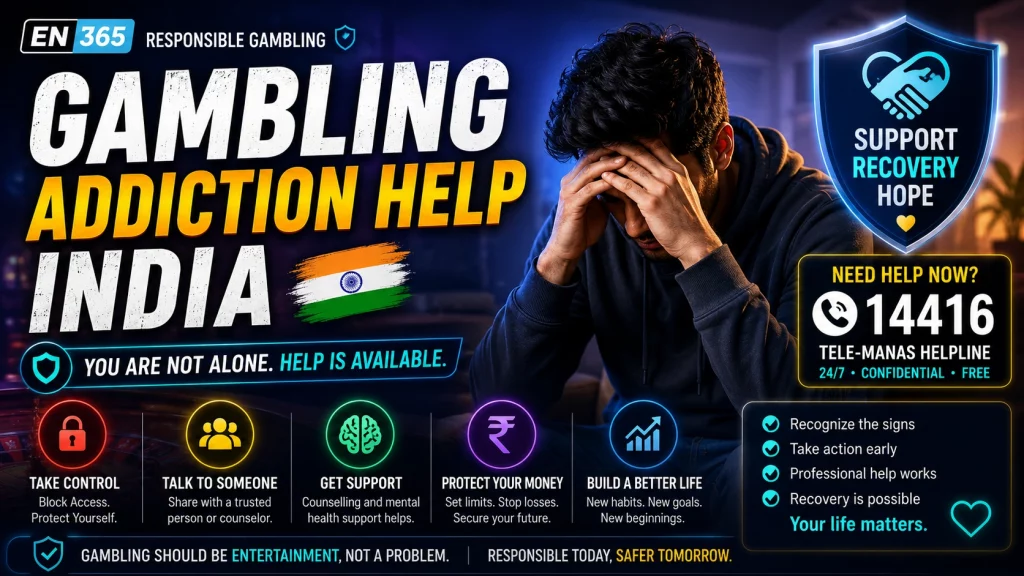
Gambling addiction is not a weakness of character. It is a behavioural addiction pattern where gambling-related activity becomes difficult to control despite financial, emotional, family, study, or work-related harm. In India, this topic should be treated seriously because online money gaming and betting-related risks have become a public policy concern, and mental health support systems such as Tele-MANAS exist for people experiencing distress or loss of control. Tele-MANAS is India’s national tele-mental health service, available 24/7 through the helpline 14416, and official updates say it operates across all States and Union Territories through Tele-MANAS cells.
A person may need help when gambling stops feeling optional. Warning signs include trying to recover losses, hiding activity, borrowing money, feeling anxious after spending, losing sleep, neglecting responsibilities, or continuing even after deciding to stop. These signs should not be ignored. Early support is safer than waiting until the damage becomes severe.
In India, gambling addiction help can involve confidential helplines, mental health counselling, family support, financial boundaries, blocking tools, and professional care. AIIMS-related clinical literature also recognises behavioural addictions as an area requiring specialised services, including gambling disorder and related help-seeking barriers.
When Gambling Becomes a Problem
Gambling becomes a problem when control starts weakening. The issue is not only how much money is lost. The issue is whether gambling begins to affect decisions, emotions, relationships, or daily stability. A person who keeps gambling to recover losses is already in a risk pattern, even if the amount seems small at first.
Some people notice the problem through money. Others notice it through secrecy, stress, anger, guilt, or constant checking. A person may promise to stop, then return again after boredom, pressure, or a stressful day. This cycle can become stronger when gambling is available through a phone, digital wallet, or fast online interface.
The safest first response is to interrupt access and speak to someone trustworthy. That can be a parent, guardian, counsellor, doctor, teacher, or a helpline. If the person feels unable to stop, professional support is appropriate. Tele-MANAS can be contacted at 14416 for mental health support in India.
| Warning Sign | What It Can Mean | Concern Level | Safer Next Step |
|---|---|---|---|
| Thinking about gambling often | The activity may be taking more mental space than expected. | Early concern | Take a break and track time spent. |
| Trying to recover losses | The person may be chasing losses instead of making controlled choices. | Moderate concern | Stop access and speak to a trusted person. |
| Borrowing or using essential money | Gambling is affecting financial safety. | High concern | Stop immediately and contact support. |
| Unable to stop after deciding to stop | Control may already be seriously weakened. | High concern | Tele-MANAS mental health support |
| Hiding activity from family | Secrecy can indicate shame, pressure, or fear of consequences. | Moderate concern | Talk to a trusted adult, counsellor, or doctor. |
Why Early Help Matters
Early help matters because gambling harm often grows gradually. At first, the person may think the problem is only one bad session. Then the pattern repeats. More time is spent checking results, thinking about money, planning recovery, or hiding the behaviour. The longer this continues, the harder it can feel to stop without support.
Getting help early does not require a diagnosis. A person can ask for support simply because gambling is causing stress, secrecy, debt pressure, or repeated loss of control. This is enough reason to pause and speak with someone.
The goal is not punishment. The goal is protection. A trusted person can help block access, review finances, remove payment triggers, and contact counselling support. Tele-MANAS is designed as a confidential mental health support route and has handled millions of calls since launch according to official updates.
How Support Steps Reduce Gambling Harm
Gambling harm becomes easier to manage when support steps are practical and immediate. A person does not need to wait until the situation becomes extreme. If gambling already causes stress, secrecy, debt pressure, repeated loss chasing, or broken promises to stop, support is appropriate. The first goal is not to analyse everything perfectly. The first goal is to interrupt the pattern before it becomes harder to control.
Support usually works best when several layers are used together. One layer is personal: admitting the problem, stopping the current session, and removing payment access. Another layer is social: telling a trusted adult, family member, counsellor, or doctor. A third layer is technical: blocking websites, deleting gambling apps, setting payment restrictions, and using self-exclusion tools where available.
For India-focused readers, mental health support should be treated as normal. Gambling addiction can involve anxiety, shame, financial stress, sleep problems, and conflict at home. These are valid reasons to ask for help early. Waiting for the situation to become severe only makes recovery more difficult.
If gambling involves debt, borrowed money, rent, food, study money, or family funds, the safest step is to stop and ask for help.
Secrecy keeps the pattern active. A trusted adult, family member, counsellor, or doctor can help create a safer plan.
Removing apps, blocking gambling websites, disabling saved cards, and limiting payment access can reduce impulsive return.
Account history, bank records, and wallet transactions show the real scale of harm more clearly than memory during stress.
If gambling happens during boredom, stress, or night-time scrolling, a replacement routine helps break the automatic pattern.
Professional support can help with urges, stress, debt pressure, shame, and repeated relapse into gambling behaviour.
Why Access Control Is Part of Recovery
Access control is one of the most practical recovery steps because gambling urges often rise quickly and pass later. If access is easy during the strongest moment of the urge, the person may return before thinking clearly. Blocking access creates friction. That friction can be enough to contact someone, leave the phone, or wait until the urge reduces.
Access control can include deleting gambling apps, blocking websites, removing saved payment methods, disabling gambling-related notifications, and asking a trusted person to help manage financial access temporarily. These steps are not about shame. They are about reducing the number of quick decisions available during a vulnerable moment.
If a Login area remains easy to open, the risk of returning during stress is higher. For someone trying to stop, account access should be restricted, closed, or blocked wherever possible. Recovery is easier when the environment does not keep inviting the same behaviour.
Why Promotions Can Trigger Relapse
Promotional messages can be dangerous for someone experiencing gambling problems. A Bonus offer may look like a chance to repair previous losses or restart with less risk. In reality, it can pull the person back into the same cycle of exposure, emotional decision-making, and possible financial harm.
A person trying to stop should avoid gambling-related emails, notifications, social media ads, and reward messages. Even small reminders can reopen the urge, especially after stress, boredom, or financial pressure. Unsubscribing, blocking senders, and turning off app notifications can reduce these triggers.
Support plans should treat promotions as relapse risks, not harmless advertising. If a message encourages return after a break, it is working against recovery. A safer environment removes these prompts as early as possible.
Why Account Creation Should Be Avoided During Risk Periods
A Sign up process can feel like a fresh start, but for someone with gambling-related harm, it can reopen the cycle. Creating a new account after trying to stop is a warning sign. It may mean the person is searching for a way around previous limits, blocks, or promises.
A safer plan is to avoid new account creation entirely during recovery. If the person has already closed access somewhere, they should not replace it with another platform. The goal is not to find a different environment. The goal is to interrupt the pattern.
When urges appear, the better step is to contact support, talk to a trusted person, or move away from the device. New registration is not neutral when gambling has already caused harm. It is part of the risk chain.
Why Mobile Apps Need Strong Boundaries
A gambling-related App can make relapse easier because it keeps access close. The phone is already used for communication, payments, entertainment, and daily tasks. When gambling access sits inside that same device, the boundary between ordinary use and risky behaviour becomes weaker.
Someone trying to stop should remove gambling apps, disable related notifications, clear saved passwords, and consider blocking tools. If payment apps are connected, spending controls may also be needed. The goal is to make return less automatic.
Mobile boundaries should be treated seriously. Recovery is not only about willpower. It is also about designing an environment where the risky action is harder to repeat.
How Triggers Keep the Gambling Cycle Active
Gambling addiction often continues because triggers remain close. A trigger can be emotional, financial, digital, social, or environmental. Stress, boredom, loneliness, debt pressure, late-night phone use, sports results, promotional messages, and easy payment access can all restart the urge. The person may think the decision is sudden, but usually there is a pattern before the action.
Recovery becomes stronger when triggers are named clearly. If gambling usually happens after an argument, during exam stress, after salary payment, or while scrolling at night, that situation needs a specific plan. General promises such as “I will stop” are weaker than practical barriers such as blocking access, removing payment methods, and telling someone before the urge becomes strong.
For EN 365 readers, the main lesson is that gambling addiction help should focus on the environment as much as the individual. A safer environment reduces the number of moments where gambling feels easy, private, and immediate.
Stress, anger, boredom, and shame can push a person back toward gambling. Naming the emotion helps separate the feeling from the action.
Salary days, debt pressure, and saved payment methods can restart gambling behaviour. Payment barriers reduce impulsive spending.
Late-night scrolling and private phone use can increase relapse risk. App blockers and screen-time limits can create useful friction.
Game reviews, win videos, gambling streams, and promotional posts can reactivate urges even when the person planned to stop.
A trusted person should know the recovery plan and be contacted before the urge turns into action.
Recovery is stronger when the old routine is replaced with a concrete alternative: sleep, walking, study, family time, or counselling.
Why Gambling Content Can Trigger Relapse
A person trying to stop should be careful with gambling-related Games content, even if they do not intend to play. Reviews, streams, screenshots, prediction posts, and win stories can make gambling feel active again in the mind. This is especially risky when the person is tired, stressed, or worried about money.
The safer approach is to remove gambling content from feeds, block related keywords, unsubscribe from emails, and avoid communities where gambling is discussed casually. Recovery needs fewer reminders, not more exposure.
Why Slot Content Can Be Especially Risky
Slots content can be triggering because it often focuses on rare big wins, bonus rounds, colourful animations, and “near miss” excitement. For someone with gambling harm, these visuals can restart the idea that one more session might fix the previous losses.
The correct recovery response is distance. Avoid slot videos, demo games, screenshots, bonus feature clips, and social media pages that show wins without showing losses. The brain does not need more gambling stimulation during recovery.
Why Help Pages Should Be Clear and Direct
A gambling addiction FAQ should answer urgent questions directly. It should explain how to stop access, what to do after a relapse, how to talk to family, how to block payments, and when to contact professional help. It should not hide behind vague phrases such as “play responsibly” without practical steps.
A strong help page should also make clear that relapse does not mean failure. It means the recovery plan needs stronger barriers and more support. The next step is not shame; it is adjustment.
Why Support Links Should Prioritise Safety
Recovery-focused Links should lead to safety resources, not gambling pages. Useful links include mental health support, government health services, counselling resources, financial guidance, and account-blocking information. The purpose is to reduce harm.
For EN 365, this means a gambling addiction help page should keep navigation protective. Readers looking for help should not be pushed toward casino activity. They should be guided toward stopping, blocking, talking, and getting support.
Building a Long-Term Recovery Plan
Gambling addiction recovery is not only about stopping one session. It is about changing the pattern that makes gambling easy to repeat. A strong recovery plan reduces access, protects money, creates support, replaces risky routines, and gives the person clear steps for difficult moments.
The first rule is to remove secrecy. Gambling harm grows faster when nobody else knows. A trusted family member, counsellor, doctor, or support worker can help create structure. This may include checking payment history, removing saved cards, setting spending blocks, and planning what to do when urges appear.
Recovery should also include practical monitoring. The person should know which situations increase risk: salary days, late-night phone use, stress, boredom, debt reminders, loneliness, or gambling-related content. Once these triggers are known, the plan becomes more realistic. The goal is not to rely on willpower alone. The goal is to make gambling harder to access and support easier to reach.
Remove gambling apps, block websites, disable saved payment methods, and reduce the chance of impulsive return.
Recovery is stronger when someone else knows the plan and can help during urges, stress, or relapse risk.
Bank cards, wallets, salary payments, and borrowed funds should be protected from gambling-related use.
Stress, boredom, late-night phone use, and debt pressure should be mapped so the recovery plan fits real behaviour.
A practical replacement activity makes relapse less automatic when the usual gambling moment appears.
Recovery should be reviewed calmly: what worked, what triggered urges, and what barrier needs to become stronger.
Why Relapse Should Be Treated as a Warning, Not a Defeat
A relapse means the current plan needs stronger barriers. It does not mean recovery is impossible. The useful question is not “why did I fail?” but “what access point, emotion, or situation allowed the behaviour to return?” That answer helps rebuild the plan.
After a relapse, the safest steps are practical: stop immediately, avoid further spending, tell a trusted person, block the access route used, and review what happened. Shame can make the cycle stronger because it pushes the person back into secrecy. A calm response is more effective.
Recovery becomes more stable when relapse is handled early. One return does not have to become a long cycle. The faster the person interrupts the pattern, the easier it is to regain control.
Why Financial Repair Needs Structure
Gambling harm often includes financial stress. The person may have unpaid bills, borrowed money, hidden spending, or pressure to recover losses. Financial repair should be slow, structured, and realistic. It should not involve gambling again to “fix” the problem.
The first step is to understand the real number. Bank statements, wallet history, loan records, and unpaid obligations should be reviewed without guessing. A trusted person may help if the situation feels overwhelming. The next step is to protect essential expenses and stop all gambling-related payments.
Debt pressure can trigger relapse if the person believes one win would solve everything. This belief is dangerous. Recovery requires a repayment plan, not another risk cycle.
Why Professional Support Can Help
Professional support can help because gambling addiction often connects with stress, anxiety, impulsive behaviour, shame, and family conflict. A counsellor or mental health professional can help the person understand urges, build coping strategies, and create a plan for difficult moments.
Support is especially important when the person repeatedly promises to stop but returns again. This pattern does not need moral judgement. It needs structure, accountability, and tools that reduce access during vulnerable moments.
In India, public mental health services, local doctors, counsellors, and tele-mental health support can be part of the recovery route. The person should not wait until the situation becomes severe before asking for help.
Final Gambling Addiction Help Takeaway for India
Gambling addiction help should be practical, early, and non-judgmental. The strongest recovery plan combines access blocking, payment protection, trusted support, professional help, trigger control, and routine replacement. One step alone may help, but several layers together are stronger.
For Indian readers, the legal and financial context also matters. Online money gaming can create serious harm, and access does not mean safety. If gambling causes secrecy, debt, stress, repeated loss chasing, or inability to stop, help should be contacted early.
The main message is simple: stop the access, protect the money, tell someone, and get support. Recovery is easier when the pattern is interrupted before more harm builds.






Comments