How To Stop Gambling India
How To Stop Gambling India: A Practical First Step
Stopping gambling starts with one clear decision: access must become harder before the next urge appears. Many people wait until they feel fully ready, but gambling-related habits rarely disappear because of motivation alone. A safer approach is practical. Remove access, reduce money movement, block reminders, and create support before the next emotional moment.
For Indian players, this topic is especially important because the legal and social discussion around online money gaming has changed sharply. India’s Promotion and Regulation of Online Gaming Act, 2025 prohibits online money games and separates them from e-sports, educational games, and social gaming. The official government overview says the law was enacted to bring clarity to India’s online gaming ecosystem while firmly prohibiting online money games.
A person who wants to stop should not begin by testing whether they can “play less.” If gambling has already caused stress, secrecy, repeated deposits, debt pressure, arguments, sleep loss, or difficulty stopping, the safer goal is not moderation. The safer goal is interruption. That means blocking the route back into play before the habit becomes active again.
The first practical move is to avoid the Login path entirely. Do not check balances out of curiosity, do not browse offers, and do not revisit account pages to “just look.” That small check can restart the cycle. A stop plan works best when the person treats access itself as the trigger.
Why Stopping Requires More Than Willpower
Willpower is unreliable when gambling is connected to emotion. A person may feel determined in the morning and vulnerable at night. Stress, boredom, shame, salary day, debt pressure, or the memory of a previous win can all change the decision quickly. This is why stopping gambling should be built around barriers, not promises.
The World Health Organization describes gambling as risking money or another item of value on an uncertain outcome, and notes that casino games and electronic gambling machines are often associated with higher harm risk. Online access can make that risk more difficult to control because the distance between impulse and action is short.
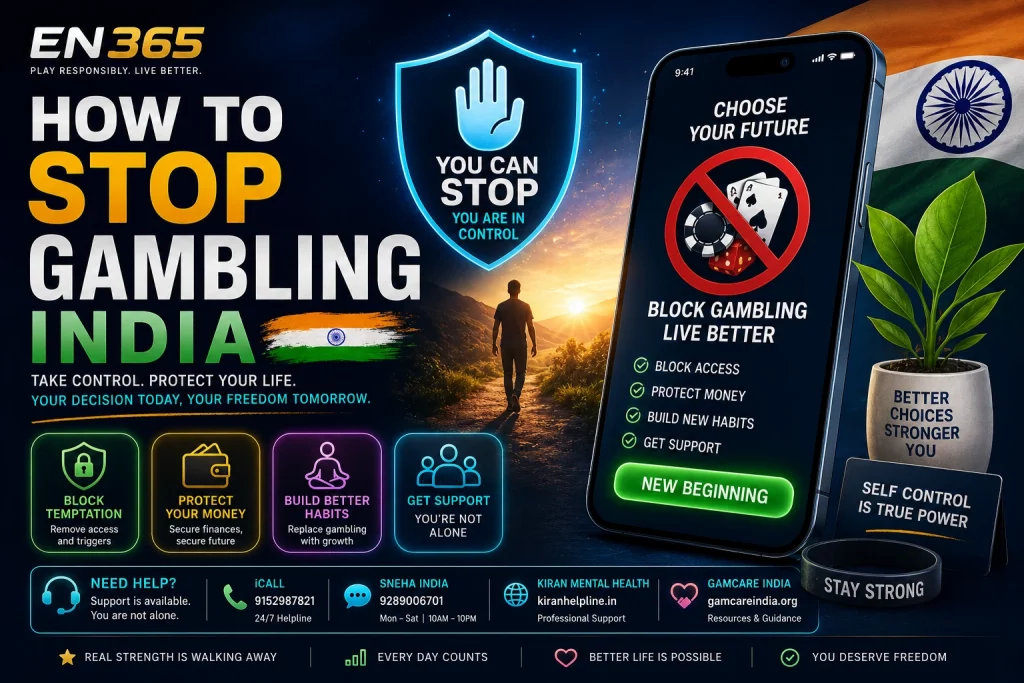
A strong stopping plan should include four layers: account blocking, money protection, device cleanup, and human support. Account blocking prevents easy return. Money protection reduces the ability to deposit elsewhere. Device cleanup removes reminders. Human support reduces isolation and creates accountability.
This structure is more effective than simply saying “I will stop.” A clear system protects the person during weak moments, not only during calm ones.
Request self exclusion, account closure, or a firm access block. The goal is to stop the return path before another impulse appears.
Priority: remove direct accessReview recent payments, remove saved methods, separate essential funds, and avoid any account movement linked to gambling activity.
Priority: reduce financial harmDelete shortcuts, disable notifications, unsubscribe from promotions, and avoid browsing pages connected with offers or game categories.
Priority: lower relapse cuesOfficial Indian communication on online gaming highlights user protection, safer digital recreation, and the prohibition of harmful online money games.
Read the PIB online gaming overviewRead the official 2025 Act PDF
Stop Chasing Losses Immediately
Chasing losses is one of the clearest signs that gambling has stopped being entertainment. It happens when a person continues because they want to recover money already lost. The next decision is no longer calm. It is driven by pressure, regret, or panic.
The safest response is to stop the session and make no further financial decision that day. Do not deposit again. Do not search for a new offer. Do not use a Bonus as a reason to continue. A promotion does not repair a loss; it usually extends the cycle and adds more conditions.
Loss chasing also distorts memory. A person may remember the one near win but ignore the total amount already spent. This is why transaction review matters. Looking at the full record replaces emotional memory with facts.
Stopping gambling means accepting that the lost money should not control the next decision. The aim is not to win it back. The aim is to prevent the next loss from happening.
Account Closure and Self Exclusion
Account closure and self exclusion are stronger than ordinary limits. Limits still leave access open. Self exclusion creates a direct block. For someone who wants to stop gambling, this difference matters.
A self exclusion request should be clear and written. The player should ask for account access to be blocked, deposits stopped, promotional messages removed, and reactivation prevented during the chosen period. If there are pending balances, the person should ask support how withdrawals or refunds are handled under the platform’s terms.
Self exclusion is not a sign of failure. It is a safety action. The Responsible Gambling Council describes self-exclusion as a voluntary agreement not to gamble for a chosen time and notes it can be an important first step in controlling gambling.
For EN 365, this page should treat self exclusion as a core protection tool. A person who has already tried to stop several times should not rely on another promise. They need a block that works even when motivation is low.
Cleaning the Digital Environment
Stopping gambling becomes easier when the digital environment stops pulling the player back. Many gambling habits are reinforced by small reminders: saved passwords, app icons, browser history, promotional emails, payment shortcuts, push notifications, and social media ads. These details may look minor, but they reduce the time between impulse and action.
A person who wants to stop should treat the phone as the first control point. Remove gambling-related apps, delete shortcuts, clear saved login details, and disable notifications connected with offers, account reminders, or inactive balances. If the person has used multiple sites, the same cleanup should happen across all of them.
The App environment is especially risky because access is fast and private. A person may open it during stress, boredom, travel, or late-night scrolling without planning to gamble. Removing the app does not solve everything, but it adds friction. Friction gives the person time to pause before acting.
The goal is not only to avoid gambling pages. The goal is to reduce exposure to triggers. A cleaner device makes stopping less dependent on constant resistance.
Delete gambling apps, bookmarks, saved passwords, browser shortcuts, and autofill details that make returning too easy during an urge.
Goal: create immediate frictionUnsubscribe from emails, block SMS offers, disable push notifications, and avoid pages that promote bonuses, jackpots, or quick wins.
Goal: reduce mental exposureRemove saved cards and wallet shortcuts, review UPI habits, and separate essential money from discretionary spending accounts.
Goal: slow down depositsTell one trusted person about the decision to stop, especially if gambling has affected money, sleep, mood, study, work, or family life.
Goal: reduce isolationProtecting Money Before the Next Urge
Financial protection should happen early because gambling urges often return suddenly. A person may feel calm after deciding to stop, but the next difficult moment can make fast payment access dangerous. Removing financial shortcuts helps prevent one weak moment from becoming another deposit.
The first step is to review recent gambling-related payments. The goal is not self-blame. The goal is clarity. Many people underestimate total spending because deposits are split into smaller amounts. A full review shows the real monthly impact.
The second step is to separate essential money. Rent, bills, groceries, education, debt repayment, medical needs, transport, and family support should sit outside any account used for discretionary spending. If gambling has already affected these areas, the person may need help from someone trusted to create a safer budget structure.
The third step is to slow down access. Remove saved cards, avoid keeping extra balance in payment wallets, and use banking tools where available to restrict discretionary spending. The more time between urge and payment, the better the chance of stopping.
Replacing Gambling Time With Real Structure
Stopping gambling leaves a gap. That gap may be emotional, financial, social, or simply time-based. If the person does not replace it, the old habit remains mentally available. A stop plan should therefore include routine replacement, not only restriction.
The replacement does not need to be dramatic. It can be a fixed walk, study block, work task, gym session, cooking routine, family time, reading, skill learning, or non-money gaming with clear boundaries. What matters is structure. Empty time is easier for urges to occupy.
A useful method is to identify the riskiest time of day. For some people it is late night. For others it is after salary, after stress, during travel, or when alone. That period should be filled deliberately with a planned activity.
The purpose is not to stay busy forever. The purpose is to move through the first weeks without giving the gambling habit space to rebuild itself.
Handling Urges Without Returning to Gambling
Urges usually rise, peak, and weaken. They can feel urgent in the moment, but they are not permanent instructions. A person who wants to stop gambling should learn to delay action long enough for the urge to lose strength. The goal is not to argue with the urge. The goal is to avoid feeding it.
The safest response is to create a fixed delay rule. When the urge appears, the person waits at least thirty minutes before taking any gambling-related action. During that time, they should not open gambling pages, check accounts, browse offers, or review old results. The delay must happen away from the trigger.
A second useful step is changing location. Moving to another room, going outside, sitting with another person, or starting a physical task interrupts automatic behaviour. Gambling urges become stronger when the person stays in the same private digital environment where they usually gamble.
A third step is contacting someone. This does not need to be a long conversation. A short message to a trusted person can break secrecy and reduce the chance of acting alone. The habit is weaker when it is no longer hidden.
The first goal is to avoid immediate action. The person should move away from gambling access before the urge becomes a decision.
Repeated urges mean stronger protection is needed. The person should reduce access further instead of trying to negotiate with the habit.
Avoiding Game Browsing During Recovery
Browsing gambling content can restart the habit even when no deposit happens. A person may think they are only checking new titles, reading rules, or looking at results, but the brain treats this as exposure. The habit becomes active again before money is involved.
This is why a person trying to stop should avoid Slots pages, live game lobbies, betting boards, promotional screens, and gambling comparison content. Recovery works better when the person does not keep testing their reaction to triggers.
The same applies to watching gambling streams, reading strategy posts, or following social media accounts connected with gambling. These activities keep gambling in the person’s attention. The stronger the previous habit, the more important it is to reduce all related exposure.
A practical rule is simple: if the content makes the person want to gamble, it should be blocked or avoided. The goal is not to prove strength. The goal is to remove unnecessary risk.
Rebuilding Trust Around Money
Gambling can damage how a person thinks about money. After repeated losses, money may start to feel abstract, especially when payments happen digitally. A person may remember only the next possible win and forget the actual cost of the pattern.
Stopping gambling requires making money real again. The person should review recent deposits, calculate the monthly total, and compare that amount with practical needs. This may include food, transport, studies, family expenses, rent, savings, medical needs, or debt repayment.
This review should be factual, not self-punishing. Shame does not build control. Clarity builds control. Once the numbers are visible, the person can decide how to protect future income more effectively.
A safer system may include separate bank accounts, stricter daily spending limits, removing wallet balances, and asking someone trusted to help manage high-risk periods such as salary day. If money access stays completely open, urges remain more dangerous.
Getting Support Without Waiting for Crisis
A person does not need to hit a severe crisis before asking for help. Support is appropriate when gambling feels hard to control, when stopping alone has failed, or when the person feels anxious about money, secrecy, or repeated urges.
Support can come from a trusted friend, family member, counsellor, financial adviser, or mental health professional. The most important part is breaking isolation. Gambling habits often become stronger when the person hides them and tries to manage everything privately.
A useful first conversation can be simple: “I am trying to stop gambling, and I need help keeping access and money under control.” The person does not need to explain every detail immediately. The first goal is to create accountability and reduce secrecy.
For EN 365, support guidance should be direct and non-judgmental. People who want to stop need practical steps, not moral lectures. The message should be clear: stopping is easier when the person has barriers, structure, and someone else aware of the plan.
Creating a Long-Term Stop Plan
Stopping gambling is not only about the first few days. The first days remove access, but the longer plan protects the person from returning when stress, salary day, boredom, confidence, or curiosity reappears. A strong stop plan should be reviewed weekly until gambling no longer feels like an active option.
The plan should include clear rules. No gambling apps. No browsing game pages. No checking old accounts. No promotional emails. No payment methods saved on gambling-related platforms. No private return “just to see.” These rules reduce negotiation, and reduced negotiation makes recovery easier.
A person should also decide what to do if the urge returns. The answer should be written before the urge appears. It may include leaving the phone in another room, calling someone, going outside, reviewing a spending record, or blocking another access point. A written response is more reliable than improvising during pressure.
The safest long-term approach is to treat gambling access as closed, not paused. If a person keeps the idea of returning open, the habit may continue mentally. Clear closure gives the person a stronger chance to rebuild routine, finances, and attention.
Keep accounts closed or excluded, remove apps, block websites, clear saved passwords, and avoid any route that makes return quick or private.
Separate essential funds, remove saved payment methods, reduce wallet balances, and review spending before high-risk periods such as salary day.
Fill the usual gambling window with planned activity, especially at night, during stress, after paydays, or when alone with the phone.
Tell a trusted person, counsellor, adviser, or support contact if gambling urges return or if money, mood, study, work, or family life are affected.
How EN 365 Should Organise Help Content
A responsible information site should make support content easy to reach. The FAQ page should explain how to stop gambling, how self exclusion works, what to do after repeated deposits, and how to reduce access when control feels weak. These answers should be written plainly, without promotional language.
The Links section should guide users toward official legal updates, safer gaming resources, account protection pages, and support information. It should not only direct readers toward commercial pages. A user who wants help should not have to search through gambling-focused material to find protection tools.
EN 365 can also improve trust by placing responsible gaming reminders near account, payment, app, and game-related articles. A user reading about access or features should also see where to reduce access. This creates a more balanced editorial structure.
Good help content should not shame the reader. It should give clear actions: stop access, protect money, remove triggers, speak to someone, and avoid returning during emotional pressure.
What to Do If Gambling Has Already Caused Harm
If gambling has already affected debt, rent, study, family relationships, work, sleep, or mental wellbeing, the person should not treat the issue as only a habit. It may require outside help and stronger barriers. A private plan can be useful, but serious harm should not be handled alone.
The first step is financial stabilisation. The person should stop further gambling payments, review urgent bills, separate essential funds, and avoid taking loans to recover gambling losses. Borrowing to repair losses often deepens the problem.
The second step is communication. A trusted person can help reduce secrecy and create accountability. This may be uncomfortable, but hidden gambling is harder to stop because there is no external interruption.
The third step is professional or structured support when needed. If the person feels unable to stop, repeatedly returns after trying, or experiences serious distress, counselling or specialist support is more appropriate than another self-managed attempt.
Final Position: Stopping Is a Safety Decision
Stopping gambling is not a dramatic statement. It is a safety decision. A person does not need to prove that things are “bad enough” before taking action. If gambling creates stress, secrecy, financial pressure, repeated urges, or loss of control, stopping is justified.
The strongest stop plan is practical. It removes access, blocks reminders, protects money, replaces risky time, and brings another person into the process. Motivation helps, but systems protect the person when motivation becomes weak.
For Indian players, the safest approach is to act early. Do not wait for a bigger loss, a larger debt, or another failed promise. The moment gambling starts affecting real life, the next step should be protection, not another session.
EN 365 should present this topic clearly: gambling is not necessary entertainment, and stopping is always a valid option. Control is not shown by continuing to gamble. In many situations, control is shown by walking away completely.






Comments